Cycode's got context?
A quick note: Everything I’m sharing here is my subjective take on Cycode’s got context? campaign as I’m not privy to their performance metrics or strategy. The recommendations at the end are offered with deep respect for the Cycode marketing team and is purely a thought exercise in how I might have approached certain elements differently.
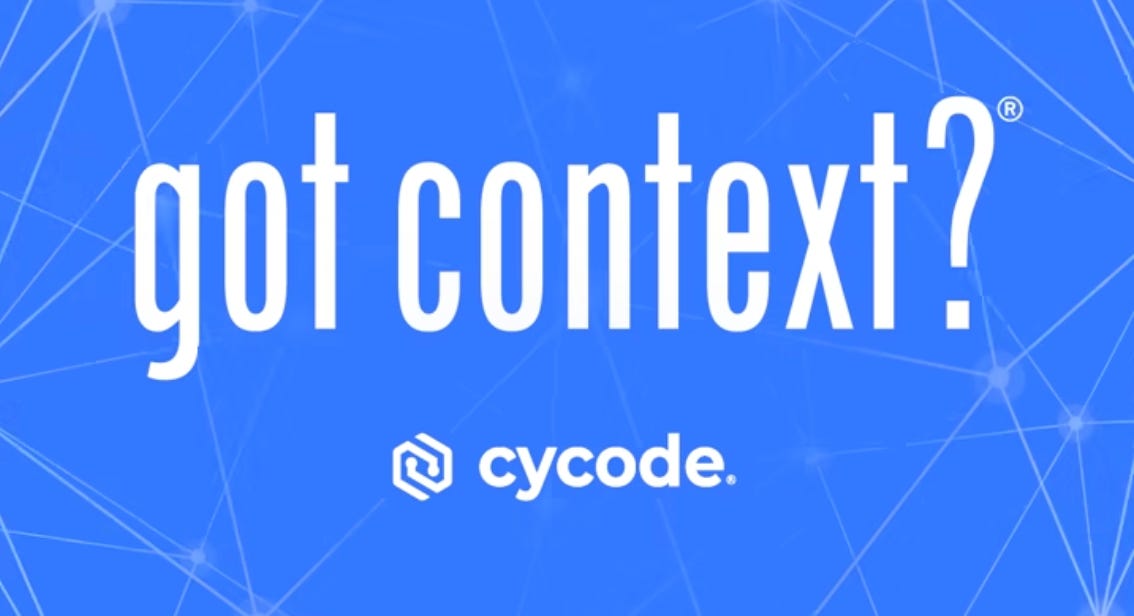
Cycode is an application security company built around a compelling conviction: the problem with AI in security isn’t the model, it’s the data the model is working with. This year, Cycode’s Chief Marketing Officer, Ronen Shetelboim, and team launched got context?, a campaign built not to explain their platform, but to name a gap.
What followed was a strategically coherent and creatively *chef’s kiss* campaign. One that gave me a ‘I have a lot to learn from this team’ feeling. And once you see where the creative inspiration came from, you’ll understand why.
The Strategic Insight
Let me start with why this campaign exists, because Ronen put it plainly in his interview response:
“At the time, the whole industry was rushing to bolt AI onto security tools. But AI without context isn’t intelligence, it’s just noise. Security teams were drowning in alerts they couldn’t trust, eager to leverage AI, but unable to get results they could actually act on.
We saw that the real unlock wasn’t a better model, it was better context. got context? was our way of naming that gap and owning it.”
That is a market POV, not a product pitch.
They’re saying here is the thing the industry is getting wrong, here is why they are getting it wrong, and here is what the fix actually looks like. The distinction matters because a POV a.k.a. narrative campaign asks the audience to agree with an idea before it ever asks them to consider a product.
And when you get someone to agree with your idea, you’ve done something far more durable than generating a click. That’s the foundation this campaign was built on.
The primary audience was product security leaders. What Cycode needed them to feel, as Ronen described it, was that:
“Cycode is the unlock to context, and therefore context is the unlock for accurate and confident AI.”
That sequencing, belief first, platform second, shaped every execution decision that followed.
What Cycode Executed Brilliantly
Borrowing the Most Recognizable Question in Advertising History
got context? is deeper than just a rename of a legendary ad.
It is a deliberate, strategic lift from got milk?, the 1993 California Milk Processor Board campaign created by Goodby Silverstein & Partners that became one of the most recognized advertising campaigns ever made.
And Cycode didn’t just borrow the format. They understood the underlying creative mechanism and rebuilt it from scratch for a completely different audience.
Want to know why got milk? worked? Because it didn’t sell milk. It made you feel the absence of milk.
The original 1993 ad opens with a Hamilton obsessive surrounded by portraits, memorabilia, and shelves of books, the most prepared person imaginable to answer a radio trivia question about who shot Alexander Hamilton.
The phone rings.
The radio host asks the question for $10,000. He knows the answer. He has always known the answer. But his mouth is full of peanut butter, and there is no milk. He cannot get the words out. The ad ends on a black screen: got milk?
The got context? campaign video, which runs 28 seconds, follows an identical four-beat structure.

Both ads follow the same logic beat for beat. Maximum prep. A moment of crisis delivered by phone. A discovery that the one critical thing is missing. A tagline that lands on a black screen as a question.
What makes the Cycode execution so impressive is that they didn’t imitate the surface; they replicated the mechanism. The got milk? ad works because it makes you feel the absence of milk before it mentions milk. The got context? ad works for exactly the same reason.
You feel the absence of context before Cycode ever enters the frame.
Both ads end on a question, not an answer. That is a precious choice. The question implicates the viewer. It doesn’t say “you need context.” It asks. And the asking is what makes it stick.
The von Restorff effect is in full force here.
With 5,000+ vendors in the cybersecurity software space, most marketing campaigns lead with threat statistics, product screenshots, and analyst endorsements. Falling into the sea of sameness or, as Torq’s CMO Don Jeter likes to call it, the epidemic of sameness. A video that opens like a scene from a 1990s black-and-white thriller and name-checks one of the most iconic ads in history stops you cold.
Different works. And different is what Cycode did.
got a great campaign landing page? Cycode Does.
Sorry I had to… The campaign landing page is worth studying because it makes a series of deliberate structural decisions. And those decisions are what separate a campaign page that does real work from one that just looks good.
The hero section opens with got context? in an oversized lowercase serif treatment, the deliberate lowercase lifted directly from the original got milk? campaign, and immediately to the right is a mosaic of real customer faces with milk mustaches, each with the got context? overlay and a one-line POV from that person.

The visual grammar is instantly recognizable. Your brain pattern-matches to a 30-year-old ad within a fraction of a second, and that borrowed cultural shorthand does something that original creative alone cannot: it builds familiarity before the conversation begins.
That is cognitive fluency working in Cycode’s favor.
The copy progression on the page is worth pausing on. “Data is noise. Context is power.” Then “You don’t need more data. You need more context.” Then a series of “Without context...” statements:
without context, data is just noise
without context, attackers have the upper hand
without context, you waste time while risks persist
without context, agents can’t make the right decisions.
This is anaphora used with intention.
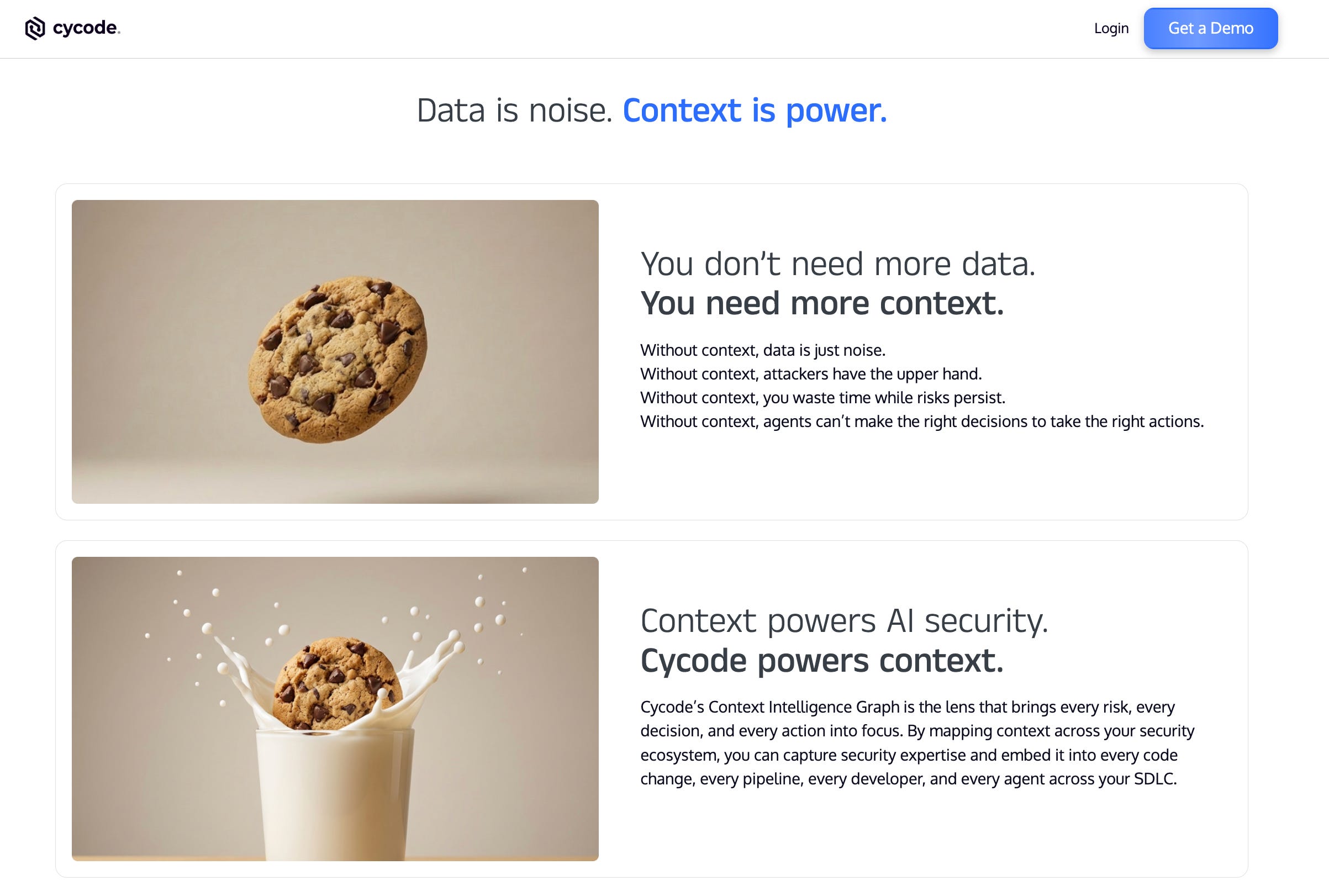
Each repetition deepens the felt absence before Cycode ever positions itself as the solution. By the time you reach “Context powers AI security. Cycode powers context,” you have already been convinced of the premise. The brand claim lands as a conclusion, not a pitch.
There is also a structural decision on this page worth calling out directly. Most campaign pages are one thing or the other, either a pure brand experience or a product education page. Cycode’s page is deliberately both, in sequence. The top half makes you feel the gap. The bottom half shows you how Cycode closes it.
That two-act structure mirrors exactly what Ronen described as the campaign’s intent: establish trust first, introduce the platform second. The page doesn’t break the spell. It completes it.
A few smaller details deserve credit.
The hero subheadline rotates through different outcomes, “Context powers Orchestration,” “Context powers Prioritization,” “Context powers Compliance,” communicating more without adding more words. The customer headshots scroll through. The logo ticker doesn’t just scroll infinitely; logos flip to new ones at irregular intervals, creating small moments of surprise that pull the eye back. These are pattern interruptions on a page that is itself a pattern interruption. The medium reinforcing the message.
Brought the Campaign to RSAC 2026
Cycode brought got context? to RSA Conference 2026, and the physical execution mirrored the creative commitments of the digital execution.
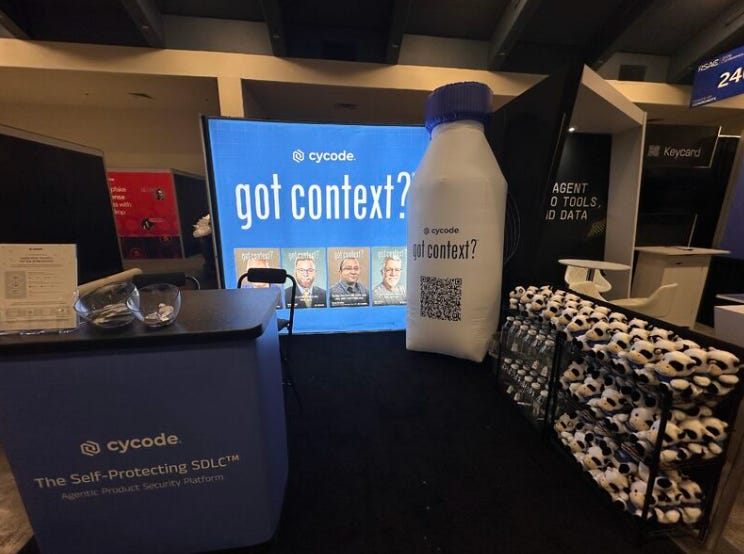
The booth centerpiece was a giant inflatable milk bottle, a recognizable object on a conference floor packed with hundreds of competing dark booths and glowing screens. You didn’t need to have seen the campaign before to be pulled in (although it definitely pulled in folks that did see the campaign).
The stuffed cows wearing got context? t-shirts and milk bottle-shaped stickers with QR codes extended the same logic into swag. Conference giveaways are almost universally forgettable. A stuffed cow wearing a campaign t-shirt gets photographed, shared, and put on a desk. It becomes a memory encoding device that travels home with the attendee, keeping the campaign alive well after the conference floor closes.
That is compounding execution across physical and digital touch points creating stronger memory encoding, the same principle that made WizZZZ at AWS re:Invent so effective.
The booth screen carried the same customer quote cards from the landing page into the physical space. When someone who had seen the campaign online walked into booth #2353, they recognized it instantly.
That visual consistency across every touch point is a mark of a campaign that was built with dedication.
A Campaign That Gives Everything Else a North Star
This is the observation I want to spend the most time on, because it’s (surprisingly) more rare than you would think in security marketing, and Cycode nailed it.
In the weeks following the campaign launch, Cycode continued to publish content that had nothing to do with the got context? creative. Webinars, announcements, summit recaps, etc. And yet every single piece reinforced the exact same idea: “AI is only as intelligent as the context you give it” and “Context is the missing link in application security.”
The campaign didn’t just name a gap. It gave Cycode a gravitational center that everything else orbits around naturally. This is what a strong foundational narrative does.
Most companies build a narrative doc then pump out content that strays away from the narrative in the name of “SEO” or “demand gen”. Cycode is producing a point of view. The difference is that content gets consumed and forgotten. A point of view accumulates. Every post, every webinar, every product announcement that reinforces the same narrative makes the previous ones more credible and the overall position harder to displace.
As Ronen put it:
“That’s why we built a campaign around a feeling, not just a feature.”
The campaign created the feeling. Everything that followed built on it.
What I Might Have Explored Differently
Put Paid Media Dollars Behind the Video
The paid got context? LinkedIn ads running alongside this campaign are good. But Cycode appears to have left the video, the single strongest asset in the entire campaign, largely as an organic piece on the landing page rather than a paid distribution vehicle.

This, in my opinion, is a significant missed opportunity albeit an easy one to fix!
The video is 28 seconds long, which is ideal for social video ads. It opens with immediate tension. It requires no prior knowledge of Cycode to land. It tells a complete story with a beginning, middle, and punchline. And it closes on a tagline loaded with 30 years of borrowed cultural equity.
You do not need to explain got milk? The pattern match is instant.
Putting paid distribution behind that video at scale would have been the moment this campaign became something the industry was more actively talking about. This is, I suspect, exactly what Ronen meant when he said the resonance surprised them and they should have launched it bigger.
A More Immersive RSAC Presence
The booth brought the campaign to life physically, and I appreciate that. But there is a difference between extending a campaign into a physical space and truly maturing it for that space.
A great example of this is what Aikido Security did at RSAC 2026 with their Infinite campaign. They took the cinematic energy of their Matrix-inspired creative and built an experience around it. You walked into their booth and felt like you were inside the campaign.
At Cycode’s booth, you walked in and saw the campaign. The inflatable milk bottle, the stuffed cows, the quote cards on the screen. All of it was recognizable and consistent, but it was largely a physical transposition of the digital campaign rather than an evolution of it.
To push this even further, a creative idea that would have closed that gap: put the desk phone from the campaign video on a table in front of the booth.

Have it ring at random intervals. When a passerby glances over, booth staff point at them and say “it’s for you.” A scripted caller on the other end recreates the got context? commercial, the injection vulnerability, the CISO calling, the AI that can see the code but doesn’t know where it lives.
That is experiential marketing at its best. The visitor doesn’t just see the campaign. They become the character in it. The “CISO CALLING” moment stops being something you watch and becomes something you feel.
That is the difference between a booth and an experience.
The RSAC landing page had the same limitation. The hero led with got context? which is the right instinct, but the body copy drifted quickly into generic language. A page that stayed in campaign voice throughout would have been sharper and more consistent with the creative ambition of everything else.
A Sustained Social Narrative
Cycode’s social strategy is strong. Their LinkedIn presence consistently reinforces the campaign narrative, and the non-campaign content we looked at earlier is proof that they understand how to build a point of view over time. That makes this next observation less a criticism and more a question of unrealized potential.
Based on my research, the single organic LinkedIn post tied to the campaign launch is a missed opportunity given the creative depth of what Cycode built. The post itself is good. But one launch post and a handful of RSAC got context? posts is a thin social presence for a campaign of this ambition.
The “without context” framework alone could have sustained weeks of serialized content. Each post taking a different security scenario and making the gap visceral and specific.
The TorqTV lead-up to RSAC is the benchmark for this kind of sustained storytelling.
Torq understood that social isn’t just a distribution channel for campaign assets; it’s a storytelling medium in its own right. A content series that built toward the RSAC reveal would have created compounding anticipation and memory encoding that a single launch post cannot replicate.
The Bottom Line
got context? is a campaign that required real conviction to make.
Borrowing from one of the most iconic ad campaigns in history is a bold creative swing. Building a 28-second video that mirrors its structure beat for beat is even bolder. And doing all of that while staying disciplined enough to let the market POV lead before the platform ever enters the conversation takes a level of strategic maturity that is rare.
Ronen said the goal was to make Cycode synonymous with context in AI security. The foundation is there. The creative is memorable. The narrative is durable. What’s left is to go bigger with it, and by Ronen’s own admission, they know it.
The hard truth is that most security marketing teams would have looked at this idea and asked whether it was too risky, too off-brand, too far from the typical playbook.
Cycode asked it anyway. And they did it with a small marketing team. No massive budget. No sprawling agency roster. Just a sharp POV, the courage to commit to it, and the discipline to stay consistent.
In a market where much of the industry has rushed to add “AI-powered” to their positioning, naming the problem with AI rather than claiming to solve it was a bold and differentiated move. And it’s a reminder that the best campaigns aren’t always born from the biggest teams.
They’re born from the brave.
Every week, I write about a marketing campaign in the cybersecurity software space that stands out strategically and/or has creative execution worth studying. And every quarter, I select three “Campaigns of the Quarter” where the marketers who led the campaigns receive a free, personalized Funko Pop. Yes, I’m serious. Here’s mine as proof:

If you’ve led a campaign you’re proud of or know someone who has, message me on Substack or LinkedIn to submit it. I want to see what you’re building.
Originally published on Campaign Telemetry.
Read on Substack