Darktrace's Defenders
A quick note: Everything I’m sharing here is my subjective take on Darktrace’s Defenders campaign as I’m not privy to their performance metrics or strategy. The recommendations at the end are offered with deep respect for the Darktrace marketing team and is purely a thought exercise in how I might have approached certain elements differently.
Darktrace is an AI-native cybersecurity company protecting over 10k orgs across 110 countries. Their ActiveAI Security Platform detects, responds to, and anticipates threats across cloud, email, network, and beyond.
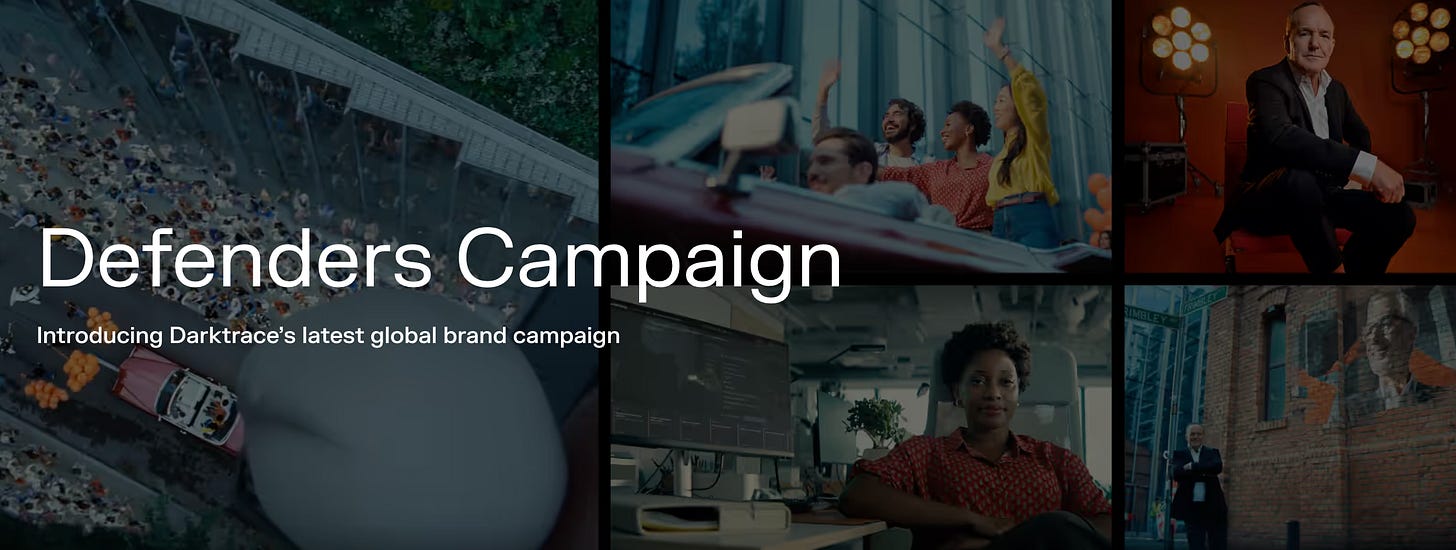
Darktrace’s VP of Brand, Jeff Rennacker, and team launched the Defenders campaign, a global brand campaign built not around what security teams are failing at, but around who they actually are.
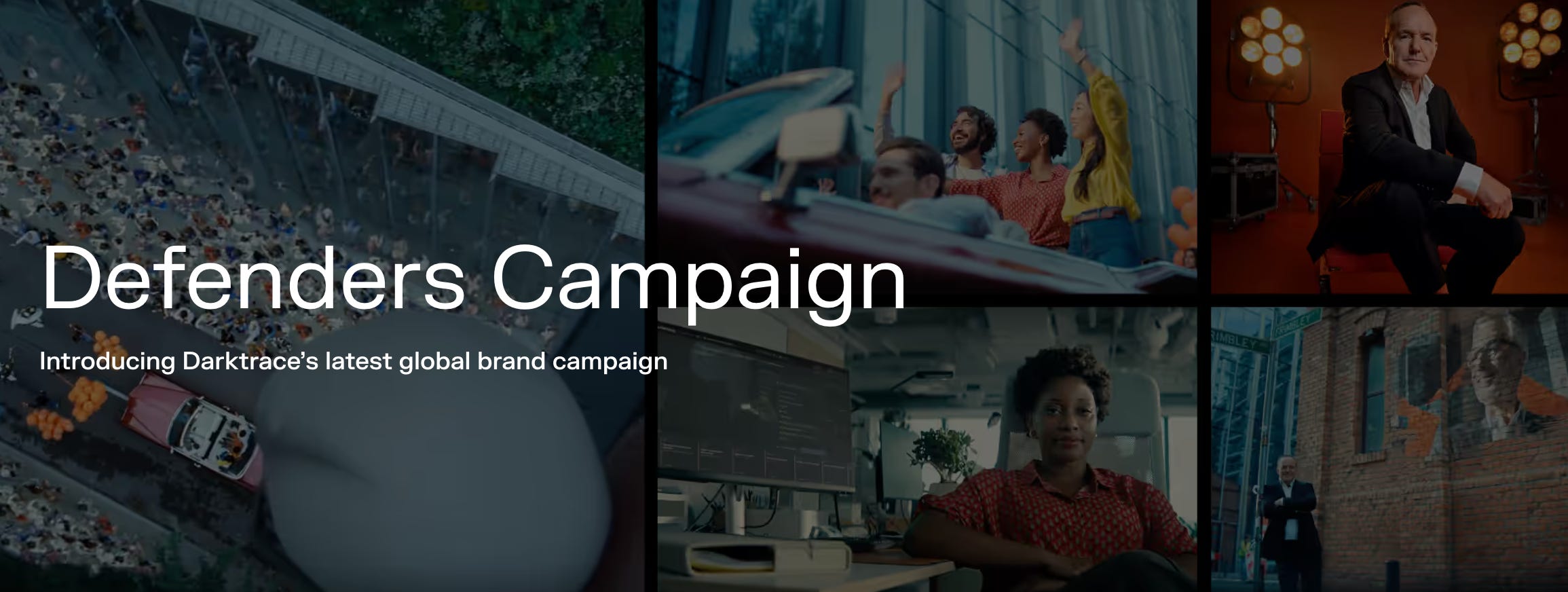
Introducing Defenders
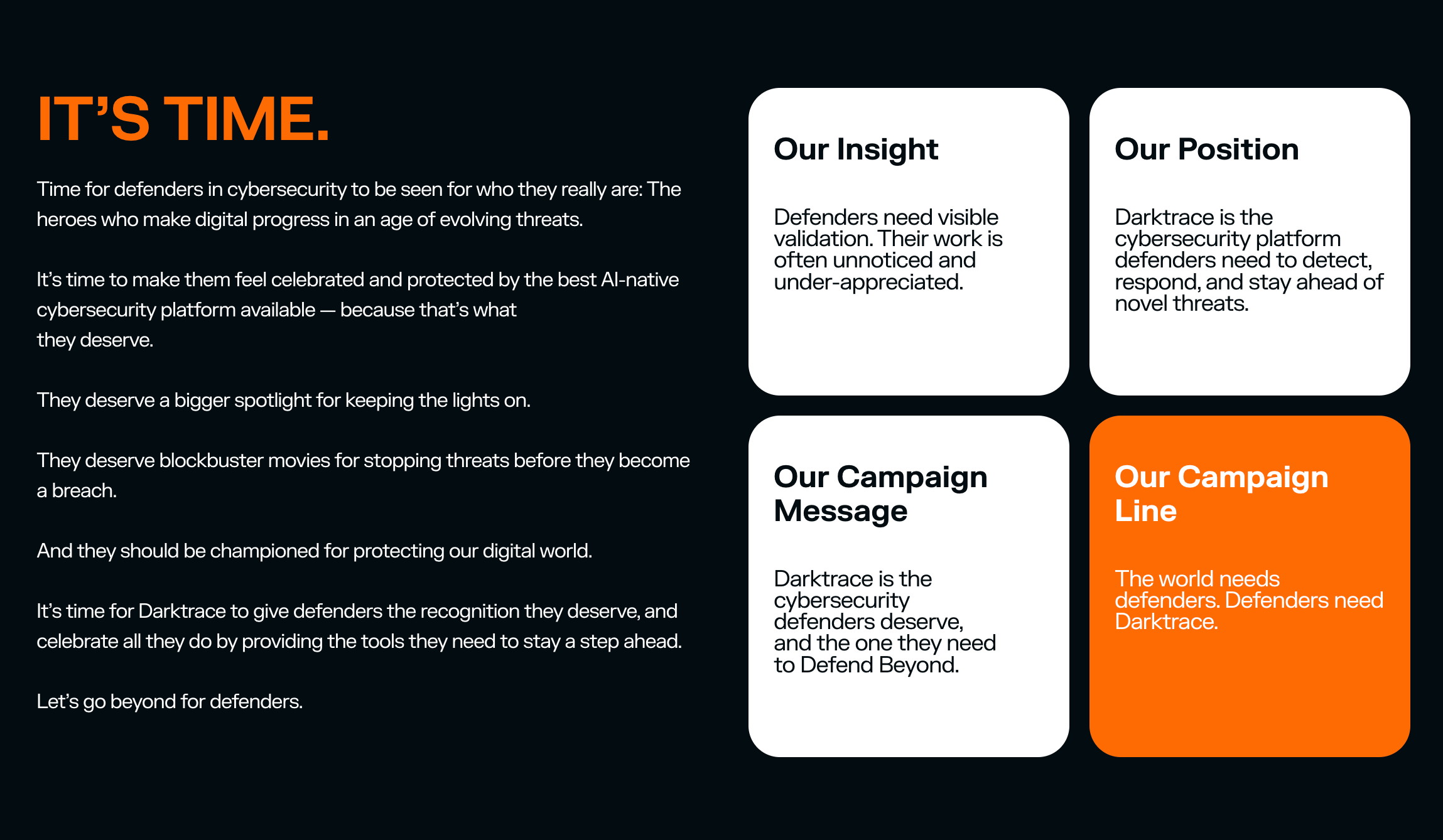
IT’S TIME.
That’s how Darktrace opens the campaign. And what follows is a brand campaign that sets a high bar for what coherent, emotionally compelling brand marketing can look like in cybersecurity.
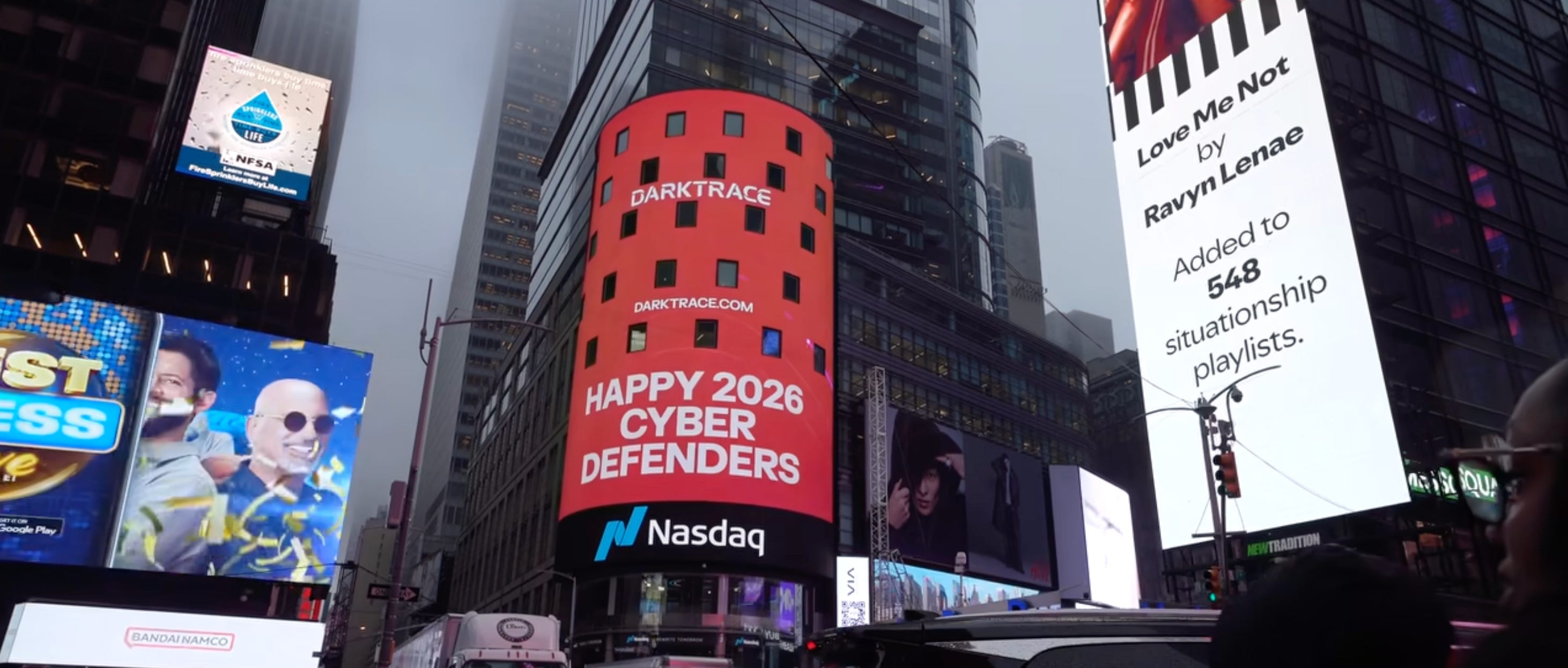
The more I dug into this campaign, the more I found. A celebrity spokesperson. A CISO experiential event. A Nasdaq MarketSite takeover. A Defender Lounge at RSA. Out-of-home advertising. Multiple video ads across every product line. A social media strategy that made every post, whether directly tied to the campaign or not, feel like it was speaking the same language. The list goes on.
But here’s the thing… this is not a volume story. It’s a coherence story. And that distinction matters enormously.
Large marketing teams are more often a curse than a blessing.
Teams get siloed. Work takes forever to launch. Messaging drifts. Darktrace, with a marketing team of meaningful size, defied all of that. Every asset I found pointed in the same direction. That doesn’t happen by accident. It requires alignment at a strategic level before a single piece of creative gets made.
The Emotional Bet
Most cybersecurity marketing is built on fear.
Here’s what’s coming for you.
Here’s what you’re not doing well enough.
Here’s what keeps you up at night.
Vendor after vendor, month after month, security leaders and practitioners get bombarded with reminders of what they haven’t done, what they’ve missed, what could go wrong.
Darktrace made a fundamentally different bet. Instead of leading with what defenders are failing at, they led with what defenders are doing right. The campaign insight, stated directly in their brand hub, is that defenders need visible validation. Their work is often unnoticed and underappreciated. These are the people securing the world’s most important data. If that data gets into the wrong hands, the consequences can be catastrophic. They are, in every meaningful sense, heroes.
There’s real psychology at play here. When you consistently tell someone they’re falling short, you activate defensiveness. When you tell someone they’re a hero, you activate identity. The second one is stickier, more memorable, and far more likely to create genuine brand affinity.
Recognition is a more powerful motivator than fear, especially for an audience already drowning in threat alerts and vendor pressure.
This isn’t a feel-good ad. It’s a strategic commitment. And the campaign tagline captures it perfectly.
“The world needs defenders. Defenders need Darktrace.”
This is a beautifully constructed line and it’s worth unpacking why it works so well.
The structure does most of the heavy lifting. It’s a two-part chiasmus where the end of the first sentence becomes the beginning of the second. “Defenders” is the hinge. It forces the reader through a logical sequence: the world depends on defenders, and defenders depend on Darktrace. By the time you land on Darktrace, it doesn’t feel like a sales pitch. It feels like a conclusion.
The first half elevates the security practitioner to a level of global importance. This is subtle, but means a lot.
It’s not just your org that needs you. The world needs you. Five words that deliver a significant piece of validation. Then the second half brings it back to something concrete and actionable. Darktrace is the tool that makes the hero more capable of doing their heroic work.
What the line doesn’t do is equally important.
It doesn’t say “Darktrace protects defenders” or “Darktrace empowers defenders.” It says defenders need Darktrace. That’s a confident claim. But because the first half has already established the defender as the hero, it doesn’t read as arrogant. It reads as a natural extension of the argument.
Flip the order and the whole thing falls apart.
Clark Gregg: The Defender’s Defender
Choosing Clark Gregg as the campaign’s spokesperson is an inspired decision, and the reasoning goes deeper than his association with Marvel.

Darktrace was explicit about this in their brand hub: they wanted his association with defending and protection without leaning into the Marvel or superhero connection.
That’s exactly the right call.
A CISO doesn’t want to be told they’re a fictional superhero. They want to be told they’re a real one.
What Clark Gregg brings instead is something more grounded and more useful.
Trustworthy.
Intelligent.
Grounded.
A composed speaker with calm authority. That’s not a superhero. That’s the person in the room who has seen everything, doesn’t panic, and knows exactly what to do. For a security leader navigating high-stakes decisions under constant pressure, that energy is deeply resonant.
His level of fame also matters. He’s recognizable without being so famous that he overshadows the message. A-list celebrities tend to become the story. Clark Gregg is famous enough to command attention and carry credibility, but the campaign remains about the defenders, not about him. The brand hub makes this explicit: he is there to celebrate defenders, not to be celebrated himself. That’s a subtle but critical distinction that shapes every creative decision downstream.
Campaign Architecture: One Video to Rule Them All
The video strategy behind this campaign is a masterclass in how to build creative that travels. Most campaigns make one of two mistakes:
They produce a single brand video and call it done, leaving the product story(s) untold.
They produce a series of product videos with no unifying narrative, leaving the brand story fragmented.
Darktrace threaded the needle between both.
The overarching campaign video does what brand advertising is supposed to do: it establishes the emotional territory, introduces Clark Gregg as the defender’s defender, and plants the campaign idea in the audience’s mind. It’s not trying to sell cloud security or network security. It’s trying to make defenders feel seen.
Then the product-line videos, one each for cloud, email, and network, do the conversion work. Once the emotional foundation is laid, a CISO watching the cloud security video already has context.
The different cuts add a layer of operational intelligence on top of the creative strategy. The 30-second full spot for environments where you have time and attention. The 15-second cutdowns for social feeds and pre-roll where you have neither.
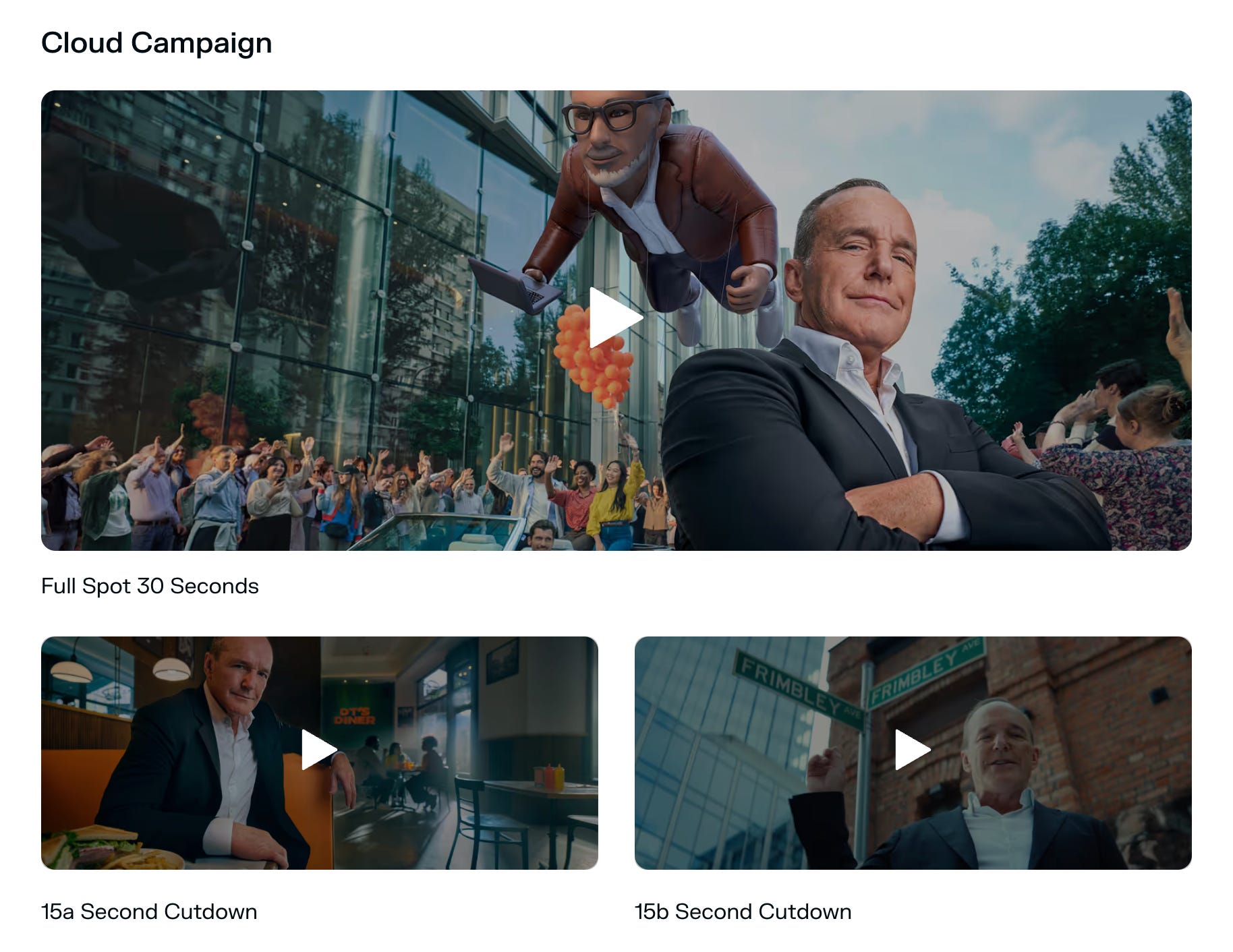
It shows that whoever architected this campaign understood that great creative dies if it can’t travel across the channels where your audience actually lives.
The truth effect is also at play: repeated exposure to consistent messaging across multiple formats and contexts builds familiarity and trust faster than any single piece of content ever could.
And the production quality throughout is worth noting. When you are the size of Darktrace, showing up as a leader means investing in work that looks and feels like a leader made it. They did.
The Brand Hub: Internal Enablement Done Right
One of the more remarkable assets in this campaign isn’t something most people will ever see.
Darktrace built a comprehensive internal brand hub that served as the strategic and creative backbone for everything the campaign produced. And it should be the baseline standard for every campaign of by a company of Darktrace’s size.
It’s comprehensive enough to align a large, distributed team and it’s concise enough that people will actually use it.
That balance is harder to strike than it sounds. Most companies err too far in one direction: either a one-pager that leaves too much open to interpretation, or a 60-page brand novel that lives on a shared drive and gets opened twice (you know this is real talk).
What makes it particularly impressive is the messaging architecture it establishes.
The hub lays out a clear hierarchy: brand-level messaging, platform-level messaging, and then product-level messaging for each solution line. Each vertical has its own distinct language. “Elevated” for cloud. “Monumental” for email. “Unrivaled” for network. That level of intentionality ensures that every asset, regardless of who creates it or where it runs, is pulling from the same vocabulary. That’s what prevents the messaging drift that quietly kills most large-scale campaigns over time.
The Defender Challenge: Where the Campaign Becomes an Experience
Most B2B physical activations fall into one of two categories: a conference booth or a hosted dinner. The Darktrace Defender Challenge is neither.
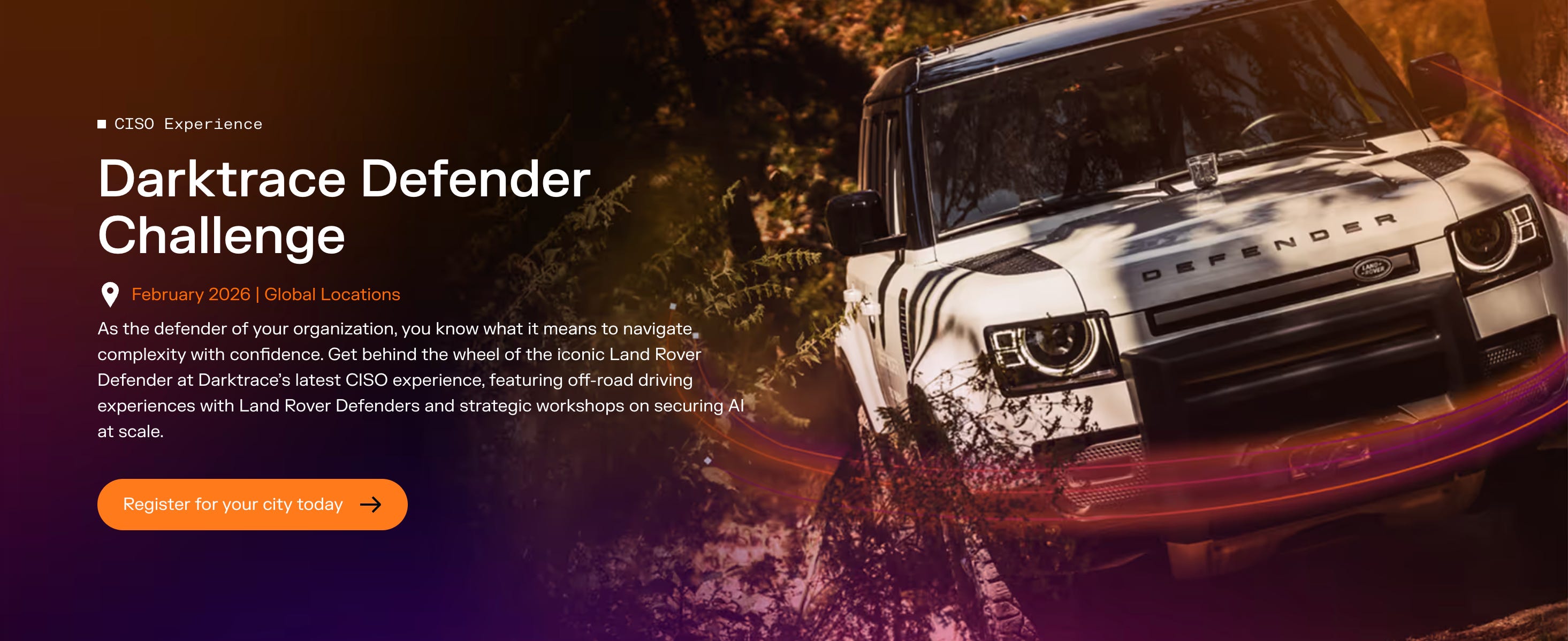
It’s a purpose-built experiential event that exists solely to bring the campaign’s central idea to life in the most visceral way possible.
Two days. Day one: off-road driving in Land Rover Defenders across rugged terrain, followed by a dinner celebrating the modern-day defender. Day two: strategic AI workshops and executive one-on-one conversations.
The wordplay earns its place here in a way that feels intentional rather than forced.
The Land Rover Defender, the defender as CISO persona, and the Defenders campaign all converge in a single experience. When you physically do something, your brain encodes it differently than when you read about it or watch a video about it. A CISO who attended the Defender Challenge doesn’t just remember Darktrace. They remember how Darktrace made them feel. That’s a fundamentally different kind of brand memory than anything a digital campaign can create.
The sequencing of the two days is also smart.
You earn the right to have a serious business conversation by first making someone feel genuinely celebrated. By the time a CISO sits down for a strategic AI workshop on day two, they’re already emotionally invested in Darktrace in a way no product demo could manufacture.
And creating this as a standalone event rather than a conference activation was the right call. Darktrace owned the entire experience.
No competing booths.
No distracted attendees.
Just defenders, being celebrated, exactly the way the campaign promised they would be. The post-event video captured that energy beautifully and extended the life of the experience well beyond the people in the room.
What I Might Have Explored Differently
Campaign Landing Page Needed To Be Built For The Campaign
The URL darktrace.com/defenders exists, but the page itself is essentially the Darktrace homepage with a different hero image.
Same product module layout. Same customer logo bar. Same platform feature breakdowns. The only meaningful difference is Clark Gregg in the hero section and a “Watch the video” CTA that signals the page is leaning entirely on the film to do the storytelling work.
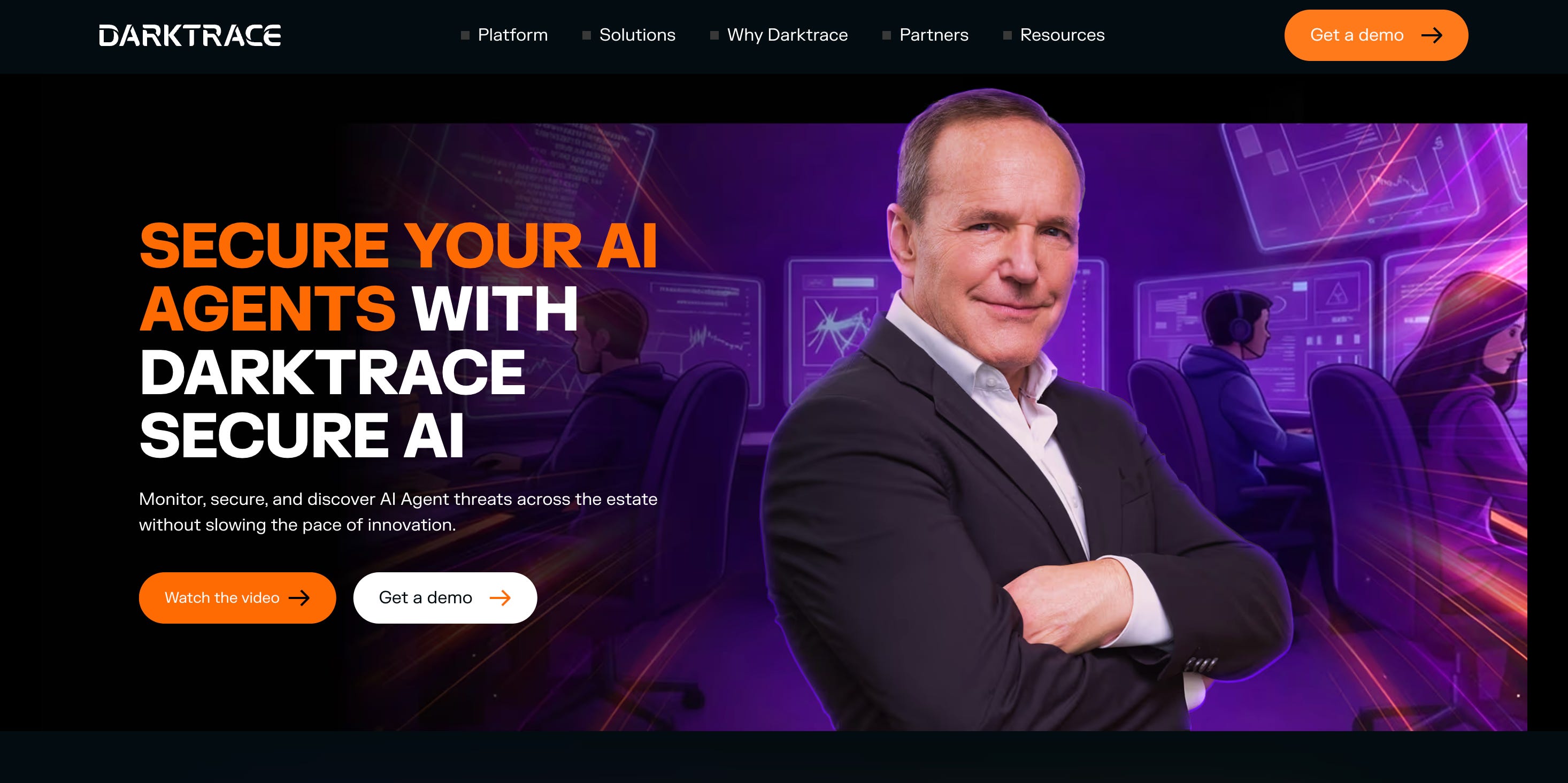
For anyone who clicks through from a campaign ad expecting to land somewhere that feels built for them, the experience is a tad jarring. The emotional momentum the campaign builds gets absorbed by a generic platform page.
The page should have been structured around three things:
Emotion
Evidence
Action
In that order.
The hero section should have continued the campaign narrative directly, speaking to the defender landing on the page.
From there, the page should have transitioned into customer stories. Many of them.
Real defenders, real names, real organizations, talking about their work and how Darktrace makes them better at it. The campaign has done all the hard work of establishing the emotional frame. Customer stories are where that frame pays off. They’re the evidence that the campaign’s promise is real. Without them, the page risks feeling like a brand statement rather than a movement.
And leading with the PGA Tour partnership as the first campaign asset compounds the problem.
The “Defend the Title” wordplay is clean, and the golf audience skews toward the executives Darktrace is targeting. But a sponsorship announcement is not the right first impression for a page meant to celebrate defenders.
Real defender stories should lead.
Then the campaign extensions: the Defender Challenge, the PGA Tour, Darktrace Live. And only then the platform and different product lines.
The RSA Presence Left Points On The Board
The Defender Lounge was a solid activation. A dedicated space for defenders to recharge during one of the most exhausting weeks of the year.
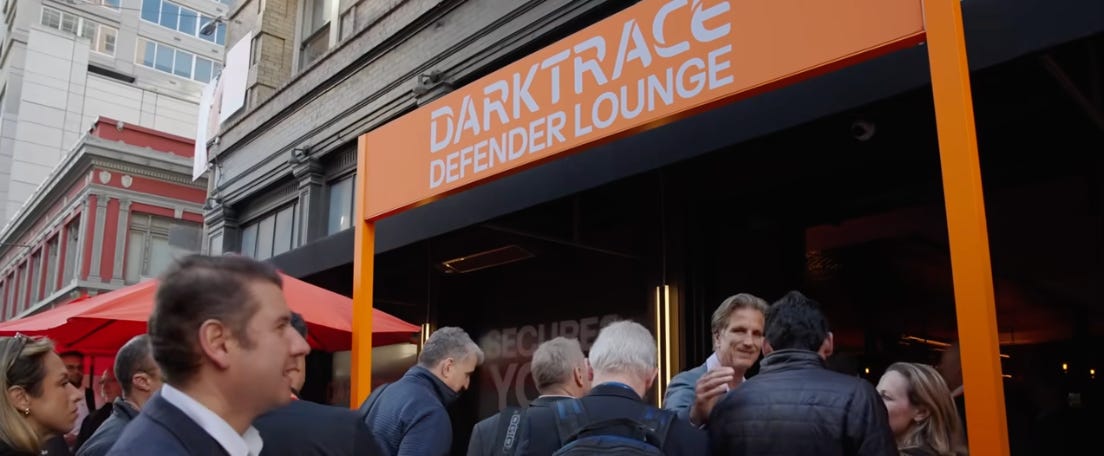
The hospitality itself is the message. But the broader booth experience defaulted back to standard Darktrace brand execution rather than extending the campaign’s creative theme into the physical space.
RSA is the single highest-concentration moment of the year for the exact audience this campaign was built for.
The opportunity was to turn the entire Darktrace presence into an immersive expression of the Defenders campaign. The Defender Lounge showed they understood the concept. The rest of the footprint suggested the campaign’s reach didn’t fully extend into the event execution.
The billboard placement near the Moscone Center during RSA week also missed, in my opinion.
“Secure your AI agents with the leading AI cybersecurity” is product messaging. “The world needs defenders. Defenders need Darktrace.” on a billboard during RSA week, when every CISO and security practitioner in your target market is in that city, would have been a far more powerful statement.
But I get it… the push for AI on everything is real. I wouldn’t be surprised if this is a battle the brand team fought diligently for.
The Bottom Line
The Defenders campaign is an incredible piece of work, and what makes it strong is not any single asset.
It’s the coherence.
Every touchpoint, from the brand film to the LinkedIn posts to the Defender Lounge to the Nasdaq MarketSite takeover, is speaking the same language and serving the same idea.
In a category where most vendors default to fear, Darktrace chose recognition. In a market where most large teams produce fragmented work, Darktrace produced something that works together.
The world needs defenders. And defenders, it turns out, respond to brands that treat them like it.
Every week, I write about a marketing campaign in the cybersecurity software space that stands out strategically and/or has creative execution worth studying. And every quarter, I select three “Campaigns of the Quarter” where the marketers who led the campaigns receive a free, personalized Funko Pop. Yes, I’m serious. Here’s mine as proof:

If you’ve led a campaign you’re proud of or know someone who has, message me on Substack or LinkedIn to submit it. I want to see what you’re building.
Originally published on Campaign Telemetry.
Read on Substack