Orca Security's The Cloud is Yours

A quick note: Everything I’m sharing here is my subjective take on Orca Security’s The Cloud is Yours campaign as I’m not privy to their performance metrics or strategy. The recommendations at the end are offered with deep respect for the Orca marketing team and is purely a thought exercise in how I might have approached certain elements differently.
Orca Security is the cloud security platform that identifies, prioritizes, and remediates security risks and compliance issues across the enterprise’s cloud estate (AWS, Azure, Google Cloud and Kubernetes).
Founded in 2019, the company built its reputation on agent-less tech, the ability to see across the full cloud estate without deploying an agent on every workload, and to surface prioritized risks from a single view. By 2022, when this campaign launched, Orca had $640M in funding and was one of the fastest-growing players in a crowded cloud security market, but it was still very much in the phase of teaching the market who it was and what category it played in.
The Campaign
Based on my research, The Cloud is Yours was Orca’s biggest brand campaign at the time of launch, and the company was explicit about treating it more than just a campaign. In the launch blog, CMO Meghan Mitchell-Marks framed it as:
“a rallying cry to everyone who manages, uses, and secures the cloud.”
The strategic thesis was empowerment and transparency: the cloud belongs to you, and Orca is the solution that lets you own it with confidence rather than fear.
The campaign was anchored by a 60-second brand film, cut down into 30 and 15-second versions, supported by a dedicated landing page and a launch blog. The film is the centerpiece, so that’s where we’ll spend most of our time.
What Orca Executed Brilliantly
The Emotional Inversion
The decision that really stood out to me is the order in which the campaign video makes you feel things. The film doesn’t open on a breach, a countdown clock, or a wall of red alerts. It opens on aspiration.
“Taking business to the cloud has taken innovation to heights previous generations only dreamed of.”
We watch a man at his desk, golden hour pouring through the windows, before anything goes wrong. The film celebrates what the cloud has made possible before it ever acknowledges what threatens it. This matters.
The default emotional starting point for security marketing is fear, because fear is the easiest lever to reach for and the fastest way to justify a budget line. Orca inverts the sequence. Awe first, risk second, resolution third.
By the time the threat is introduced, the viewer is already emotionally invested in the world the film built. You care about the man because you’ve watched him thrive, so when the office explodes and he’s thrown into the sky, the stakes feel personal. This taps into self-concept theory: the film reflects who the buyer wants to be, the empowered operator making impossible things happen, not the anxious defender bracing for the next incident. Buyers form stronger affinity with brands that show them their aspirational self, and Orca leads with exactly that.
Making The Abstract Physical
“The cloud” is one of the most abstract concepts in all of enterprise software. It’s a metaphor stacked on top of an abstraction. The film solves this by making it literal in the most cinematic way available: the office detonates and the protagonist is launched into an actual sky, actual clouds, falling and then flying.

The sharpest beat in the film lives inside this scene. “But with revolution comes risk. Threats more numerous than can be humanly managed. At least, if you’re flying the old way.” Falling versus flying.
The film gives you the bodily sensation of the difference between plummeting through chaos and soaring through it with control. That’s embodied cognition in play. You don’t just understand that Orca gives you control, you feel the contrast between panic and command in your own gut.
A dashboard screenshot cannot manufacture that feeling.
Restraint With The Product
There is exactly one shot of the actual Orca platform in the entire video. One.

It's a brief glimpse of an attack path on a laptop, and it goes by almost as punctuation rather than as the point. In a category that is chronically addicted to showing dashboards, Orca trusted its story to carry the message. That is a confident choice, and a rare one. It signals a team that understood the job of a brand film is to make you feel something and remember the name, not to demo the platform. The demo comes later, once the buyer has a better understanding of the platform.
The Bookend
The film opens and closes on the same office, the same man, the same desk. But the framing tells the story. At the open, the environment is normal and about to be torn apart. At the close, he's grounded and calm, and the clouds that once swallowed him whole now sit safely outside the window. Same set, opposite emotional state. It's the kind of compositional discipline most viewers will never consciously notice and all of them will feel. The visual grammar delivers the arc, chaos to transformation to resolution, without needing a single word to explain it.
A Tagline That Carries Weight
The Cloud is Yours is doing two jobs at once, and doing both well. It's an ownership claim: this is your domain, take command of it. And it's a reassurance: it belongs to you, not to the threats trying to take it.
That dual meaning is exactly why the same three words can anchor an aspirational brand film and a value prop without straining. Very few short taglines can hold both an emotional promise and a category position at the same time. Orca figured it out.
Distribution Discipline Baked In
One quiet signal I want to give Orca credit for: the film exists in 60, 30, and 15-second cuts. That tells me the team was thinking about channel fit and distribution from the start rather than making one hero film and hoping it would travel.
The 15 is built for pre-roll and social, the 30 for higher-value placements, the 60 as the anchor. That's more forethought about reach than most marketing teams bring to a video, and it's the kind of detail that separates a good campaign from a great one.
What I Might Have Explored Differently
Everything above is praise, and it’s earned. The critique isn’t that the thinking was weak. It’s that the strongest thinking ended up buried in the asset that receives the least traffic, while the assets built to travel carried only the feeling.
Here are the three things I'd have pushed on.
Leads With Feeling, Never Quite Gets To Difference
The film tells a beautiful story about the cloud being empowering and Orca making your vision clear. What it never tells you is why Orca specifically.
"Your vision is clear" is a benefit that almost any security vendor could claim, and in 2022, with thousands of security companies fighting for the same attention, a brand film that builds this much emotional equity and then doesn't plant a flag on what makes the company different is leaving strategy on the table.
Positioning Ended Up In The Asset The Fewest People Would See
Everything the campaign needed to make it whole existed. It was just in the blog.
The launch post is where The Cloud is Yours actually gets explained: the rallying cry framing, the 451 Research stat that 72% of organizations run multi-cloud with security as the top challenge, and Avi Shua’s founder quote articulating Orca’s differentiator,
“companies deserve to see and detect all cloud security risks from a single view, with prioritized findings based on the impact to their business.”
That founder quote is the single clearest piece of differentiation in the campaign, and it’s buried in a blog rather than surfaced on the landing page where the traffic and the intent actually were. The team had the strategic clarity. They proved it in the blog. They just didn’t distribute it to where it would do the most work.
Which brings me to the landing page.
I want to give credit first, because I ding brands constantly for not building campaign landing pages that continue the creative, and Orca built one. Not every campaign needs a dedicated page, but a brand campaign at this level should treat one as a baseline asset, and Orca cleared that bar. The page even included a gifting component, an Ember Smart Mug tied to a demo request, which is a good way to drive action in a market where a prospect has 5,000+ other vendors competing for the same click. All of that is right.
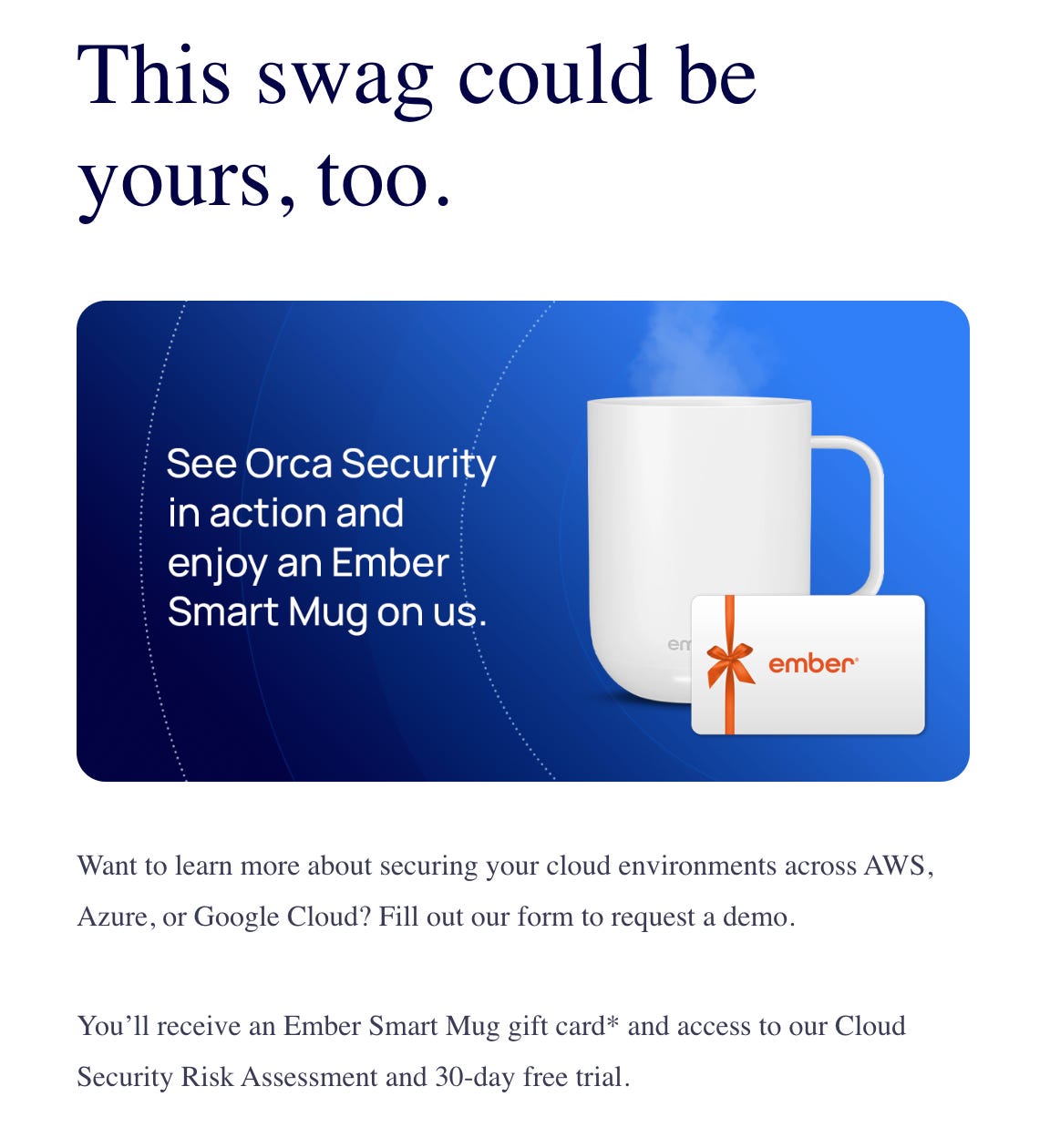
But the page had two soft spots.
The gift itself could have been braver. An Ember mug is a pleasant object, but it’s also the default premium-ish B2B swag of that era. It signals “we have budget” more than “we understand you.” Compare it to how Wiz approaches gifting, with apparel and items designed like they were made by someone who actually knows security people, and the difference between generic generosity and specific generosity becomes obvious.
More importantly, the page repeated the film’s gap rather than closing it. It carried the aspirational headline and the video, then jumped straight to a demo form, with almost nothing in between explaining what Orca solves, why it’s different, or who vouches for it.
The campaign kept building emotional momentum and then not capturing it. The landing page was the natural place to translate “you’ll feel empowered” into “here is what empowerment looks like in your actual cloud environment,” and it didn’t take the swing.
The Hero Was Always Alone
The film is about the person who "manages, uses, and secures the cloud," and it renders that person as a solo hero from open to close.
But cloud security is a team sport, and the buyer is very often a leader thinking about protecting an org, not just protecting themselves. There was an opportunity to widen the lens even once, to show that the empowerment extends to a team rather than an individual. It would have made the line "your business is secure" land harder, because a business is, by definition, more than one person flying alone.
The Bottom Line
The Cloud is Yours is a strong brand campaign built on an instinct most security marketers still get wrong four years later: lead with what your buyer aspires to, not with what they're afraid of. The film is crafted, the tagline carries strategic weight, and the emotional architecture is sophisticated. Orca understood that you earn the right to talk about risk by first honoring the ambition that created the risk.
The reason this campaign didn’t fully compound isn’t a failure of creative. It’s a failure of distribution of strategy. They articulated it clearly, they just articulated it in a blog while the film and the landing page, the assets built to travel, carried only the emotion. The lesson for the rest of us is that a brand campaign this well made deserves a connective layer that follows the viewer from the feeling to the differentiator, and that layer belongs where the traffic is.
Lead with aspiration. Make the abstract physical. Trust the story over the dashboard. Orca got the hardest parts right in a brand campaign, and the parts it left on the table are the ones that are actually easy to fix. That’s the good kind of gap to have.
Every week, I write about a marketing campaign in the cybersecurity software space that stands out strategically and/or has creative execution worth studying. And every quarter, I select three “Campaigns of the Quarter” where the marketers who led the campaigns receive a free, personalized Funko Pop. Yes, I’m serious. Here’s mine as proof:
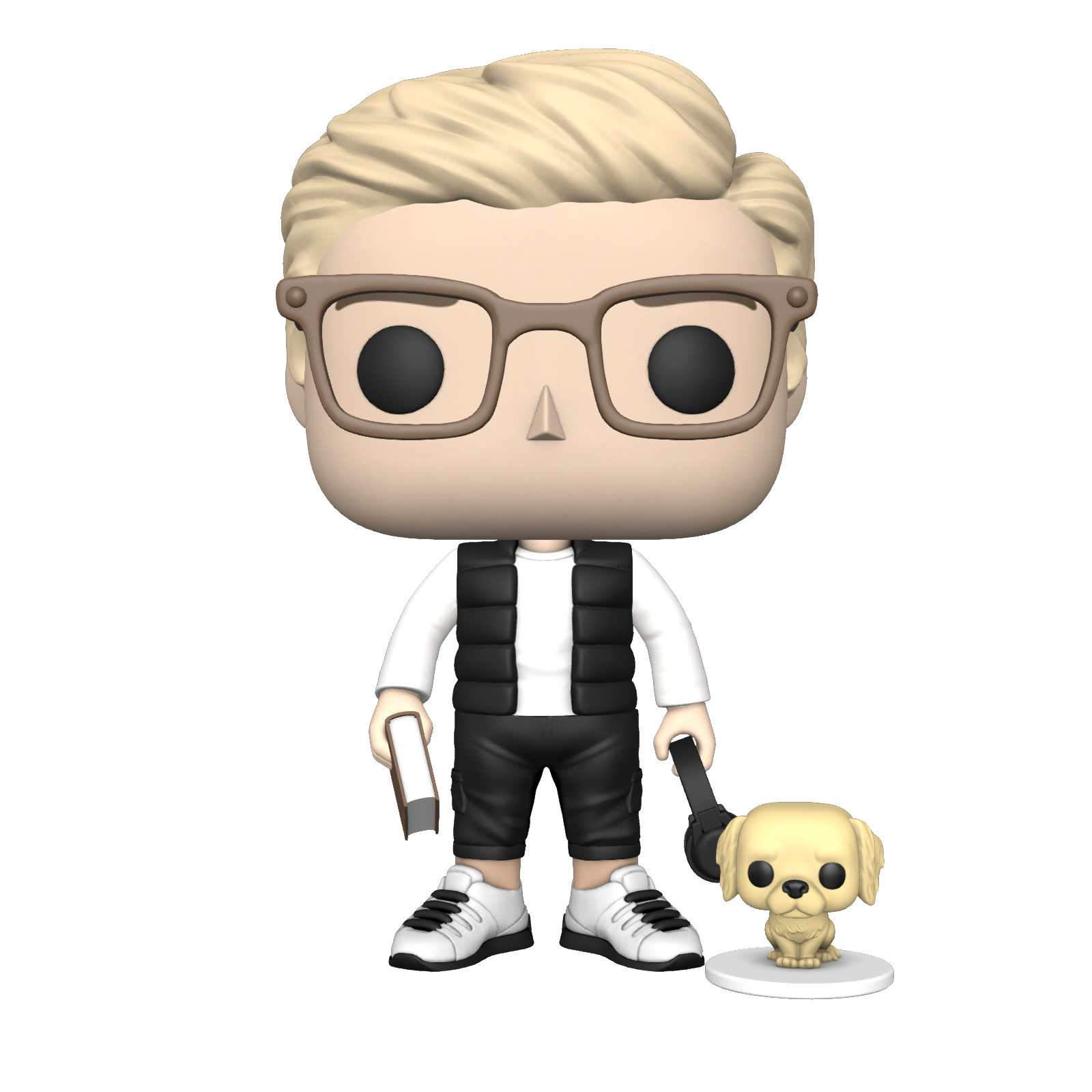
If you’ve led a campaign you’re proud of or know someone who has, message me on Substack or LinkedIn to submit it. I want to see what you’re building.
Originally published on Campaign Telemetry.
Read on Substack