Pentera's Changing the Cyber Game
A quick note: Everything I’m sharing here is my subjective take on Pentera’s Changing the Cyber Game campaign as I’m not privy to their performance metrics or strategy. The recommendations at the end are offered with deep respect for the Pentera marketing team and is purely a thought exercise in how I might have approached certain elements differently.
Now, let’s talk about the beautiful game.
Who is Pentera?
Pentera provides AI-powered automated security validation for enterprise security teams. The platform emulates real-world attacks across on-prem, cloud, and external environments to reveal what is actually exploitable and what is not. That means teams can validate their defenses, prioritize remediation by validated impact, and prove measurable risk reduction to security leadership, rather than guessing at where they are exposed.
Changing the Cyber Game Campaign
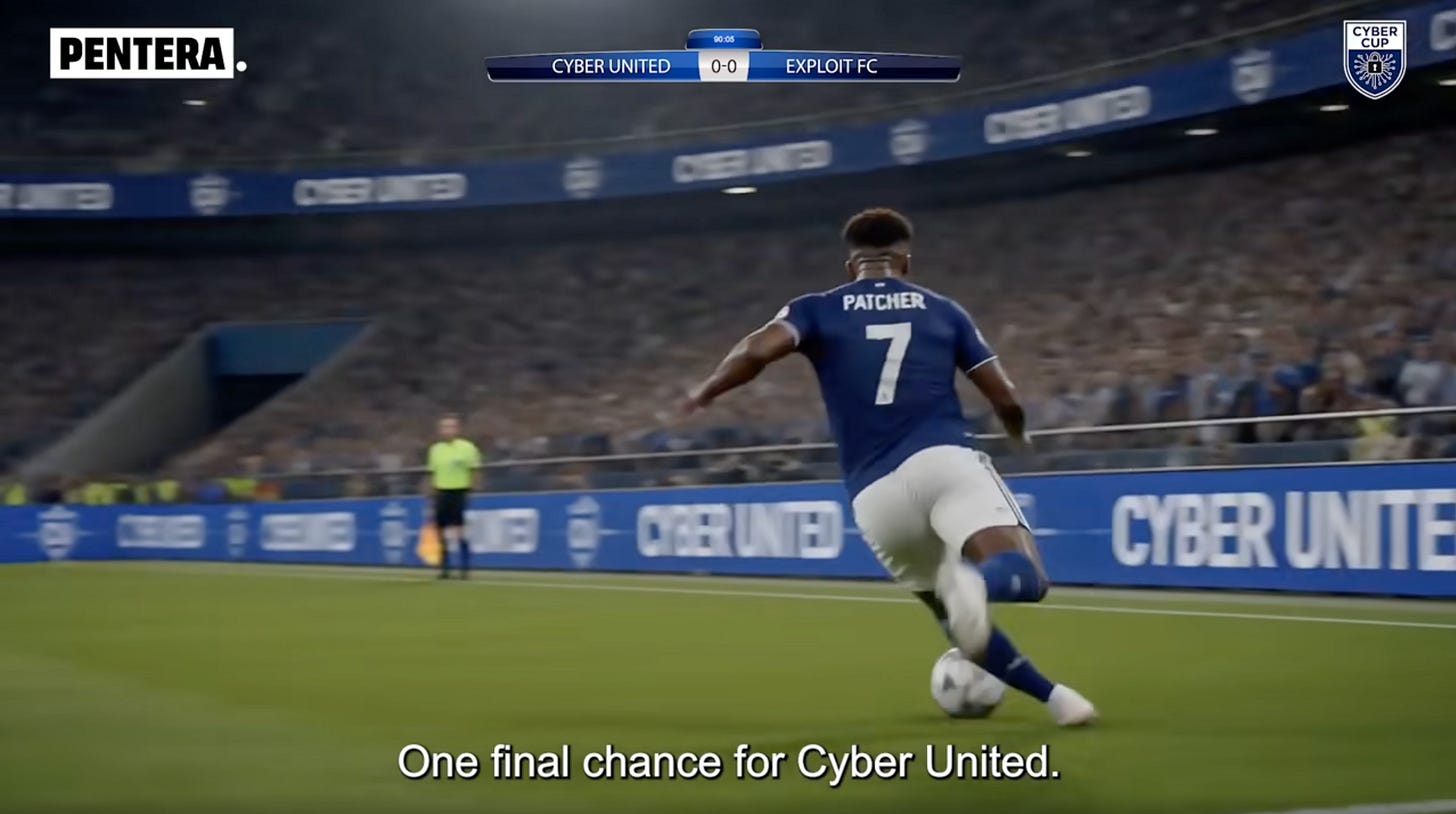
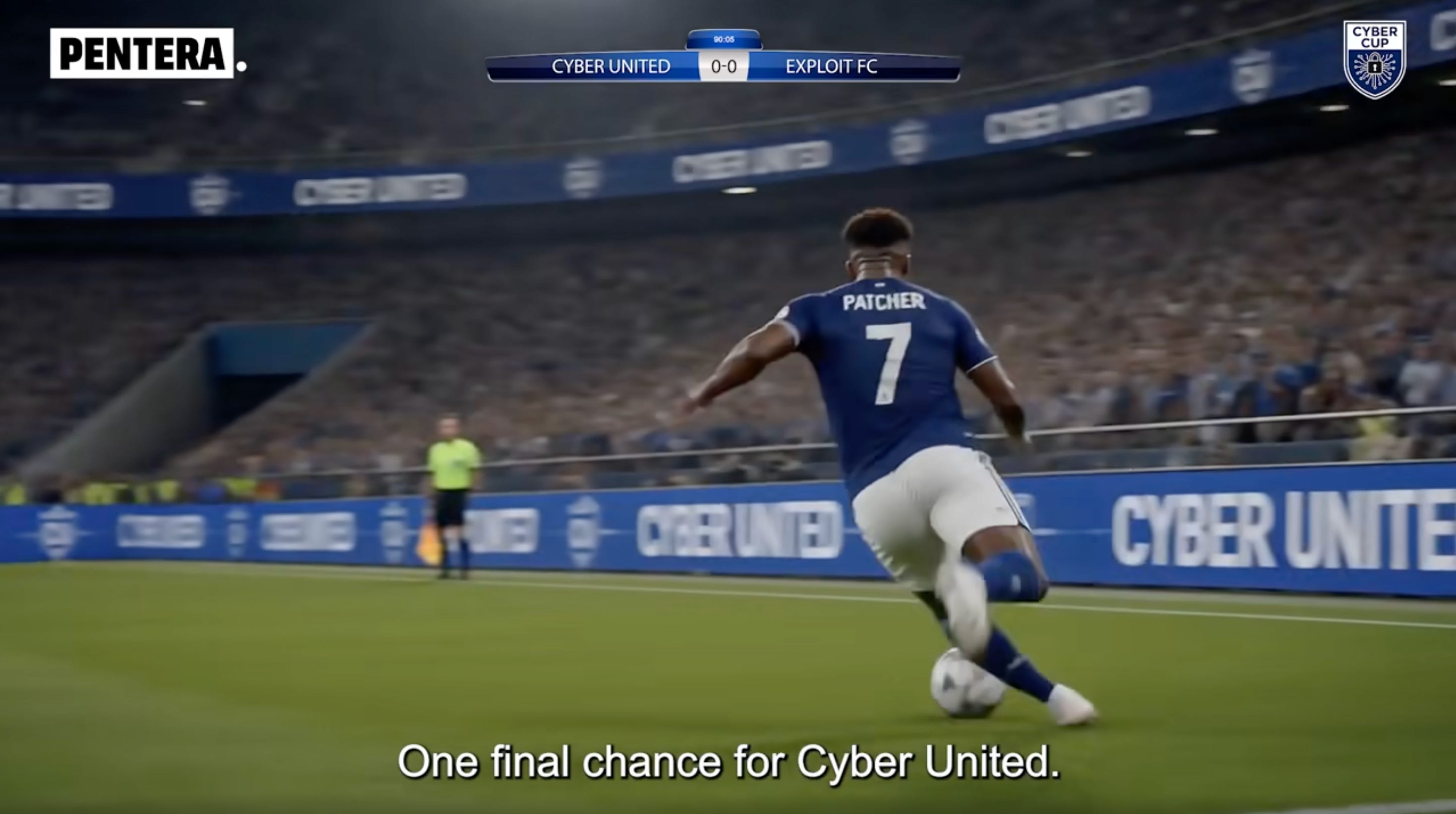
Changing the Cyber Game is built around a fictional soccer world. There is Cyber United, the defenders in blue, with a full CU crest and a stadium. There is Exploit FC, the attackers in red. There is a villain roster with names, De Ciso, Hackimi, De Breach. And there is Pax, a goat mascot in a Pentera hoodie, watching the match from the couch with his buddies.
The campaign runs across a hero film and a set of shorter videos, each closing on the same tagline, Changing the Cyber Game, and each pointing to a blog written by Erez Yalon, Pentera's VP of Cybersecurity Technology.
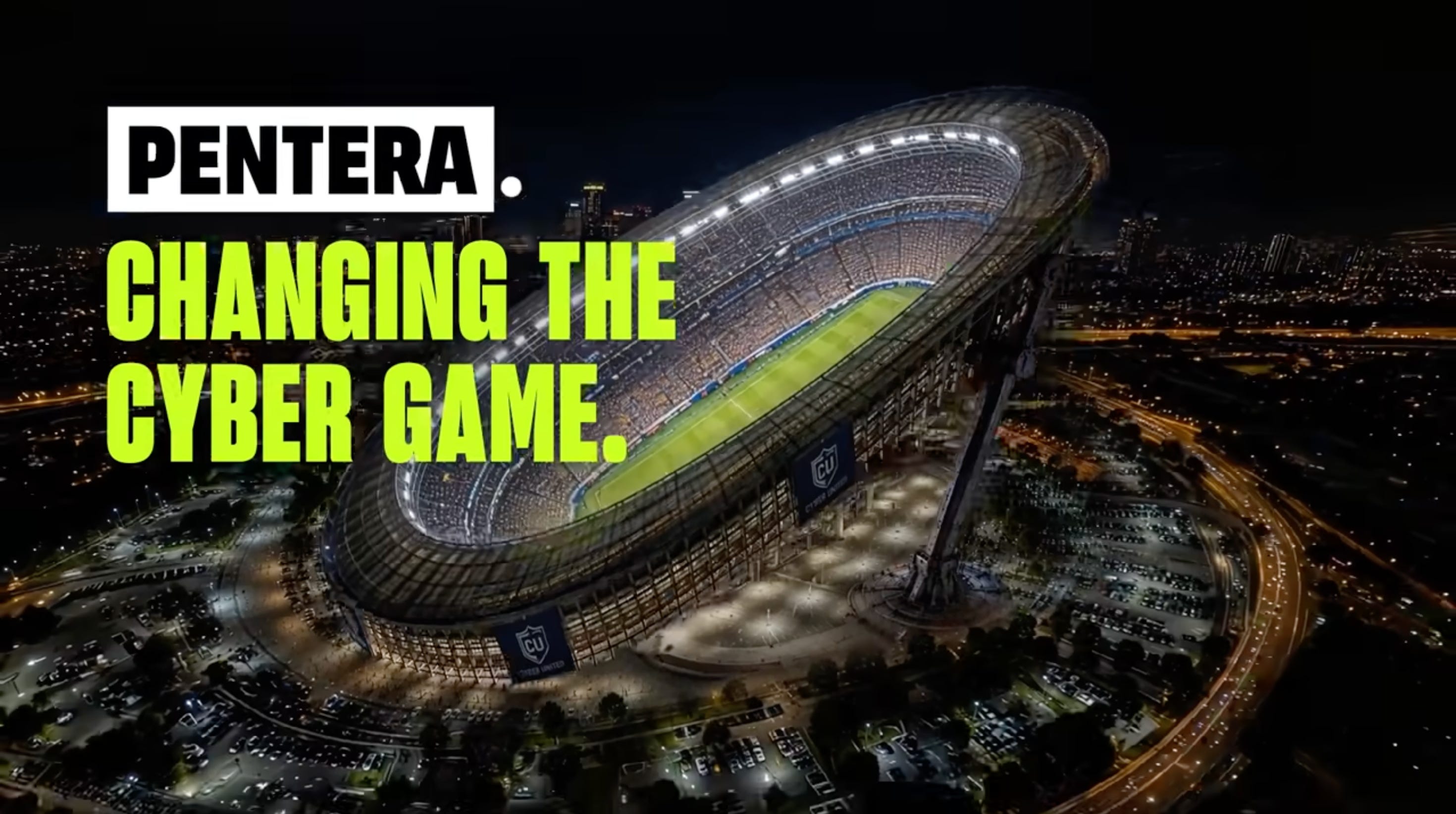
The hero video is tense. A 0-0 Cyber Cup final, a shot off the crossbar, the ball sitting on the line, and then Pax, from his living room, tilts his television. The entire stadium tilts with it, the winning ball rolls across the line, and Cyber United takes the cup. Electric…
The shorter videos each isolate a single idea. In one, an attacker misses a penalty and the goalkeeper notes he spent more energy adjusting his gloves than making the save. In another, an attacker lines up a free kick against a defensive wall that keeps extending until it spans the entire pitch. The final video, a man streaking across the pitch… because some exposures are impossible to see. C’mon that’s good!
Taken together, the videos build a little Pentera soccer universe in service of one idea. Changing the Cyber Game. Let’s dive into the mechanics.
What Pentera Executed Brilliantly
The reason this campaign works isn’t because it’s about soccer. It’s all about when Pentera ran it.
The World Cup final game between Argentina & Spain happened on July 19th, and the entire world has been watching both the tournament and this game. Pentera looked at that and made a decision: to step into a cultural moment the whole planet is already paying attention to, and to do it well enough that they earned their place in the moment rather than intruding on it.
Tomer Werechson, Pentera’s Senior Manager of Video & Creative AI, put the thinking plainly when I asked him about it.
“We knew the World Cup was going to dominate people’s attention. Instead of competing with it, we embraced it and made it part of our story.”
Borrowing attention is very easy to talk about. But it can be so, so hard to do especially in a start up. Every week you’re swimming in new requests (launch industry campaigns, update the pitch deck, what’s our ABM strategy). This constant state of chaos can make it challenging to slow down and recognize when a moment is an opportunity.
Pentera timed a soccer campaign to the exact window when soccer is the only thing on the collective mind. I applaud them on the quality of the campaign, but what’s more impressive to me is slowing down, committing to an idea, and ACTUALLY EXECUTING.
The smartest strategic choice in the campaign is the architecture. Pentera didn’t make a single video, which would’ve been the easy decision. They made a tentpole and then a set of chapters. And this was deliberate from the start. Tomer said,
“We knew one video wouldn’t be enough. A campaign loses momentum if you’re asking people to engage with the same asset over and over again. That’s why, over the past two or three years, we’ve built every social campaign as a series.”
So they surrounded the hero video with shorter chapter videos and a blog, each reinforcing the same message from a different angle.
That structure buys them something a one-off never gets: room to breathe. A campaign built on one video has to say everything at once, which usually means you have to sacrifice an important piece of info. A campaign built as chapters can make one clean point per asset and let them accumulate into a full argument over several weeks. It also gives the team multiple moments to re-engage the same audience instead of relying on a single launch day. The real win is building something repeatable instead of disposable, a format you can keep running rather than a video that is spent the moment it is viewed. And all of it, strategy to graphics, was made in-house.
Then there is the destination.
We talk constantly in this newsletter about how great campaign creative deserves a place to land, a destination that continues the story rather than dropping the viewer onto a generic page. Pentera built one. Every video points to a blog by their VP of Cybersecurity Technology, and I love that they chose the blog format specifically, because the long form is what the argument needed.

The video create the feeling; the blog does the reasoning. It resolves the metaphor into a three-part case: frontier AI models are now commoditized and available to both sides, continuous validation has replaced the point-in-time pentest, and context is the one advantage the attacker can never hold. “Their players are running the field blindfolded, while we have super vision” is the entire thesis in a single line. The blog has the word count to explain the thesis thoroughly.
The last thing worth naming is how the videos were made. This entire campaign was produced with generative AI. You can tell. And it doesn’t matter. The quality clears the bar where the question stops being “is this AI” and becomes “does this work,” and it works.
What I find most compelling is not the speed or the cost saving, real as those are, but something Tomer said about what happens before production even starts. He described the ending, where Pax tilts his television and the whole stadium tilts with it.
“A few years ago, that would’ve been a very difficult idea to pitch. Not just because producing it would’ve been expensive, but because you’d spend weeks trying to explain it before anyone could decide if it was even possible. Now you don’t have to ask people to imagine it. You can show them exactly what you have in mind.”
And then the line I really appreciated from Tomer: “AI isn’t just a production tool. It’s a communication tool. It’s almost like an X-ray into the creator’s mind.”
X-ray into the creator’s mind. That is too good. And that is the real shift. The value is not only that AI made the videos faster and cheaper. It’s that it collapses the distance between having a bold idea and letting other people see it the way you see it. The honest footnote, is that the tool does not replace the thinking. This was, in his words, one of the most demanding AI projects he has worked on, precisely because a football match is one of the hardest things to direct, everything happening at once, the crowd, the runs, the tackles, the camera. You still need strong creative people and a strong idea. AI just gets that idea to market faster than the old playbook.
What I Might Have Explored Differently
This isn’t a knock on the work. It’s one observation, and it lands on the very thing they did best.
The strength is the serialized world. Across the videos, Pentera built a real story: Cyber United versus Exploit FC, Pax on the couch, a season climbing toward the Cyber Cup final. It had characters, stakes, and momentum.
So the final video of the campaign was the moment to pay all of that off. A championship. Cyber United lifting the cup, Pax vindicated, the whole arc closing with the same characters we have all been following. Instead, the closing film is another funny one-off: a streaker running onto the pitch of a soccer match with voiceover about how exposure is a choice you cannot afford in cybersecurity. It’s funning, but I think coordinating a Cyber Cup championship video with the World Cup final would have been a stronger choice.
The series spent weeks building a story worth finishing, and the last chapter did not finish it. The exposed idea was strong enough to run as its own moment somewhere in the middle of the campaign. The closing slot belonged to the championship the whole world had been building toward.
To be fair, Tomer told me the streaker was the one video they didn't plan in advance. The idea surfaced mid-campaign and they took the tradeoff knowingly:
We consciously decided to accept the tradeoff of pivoting slightly from the original plan to create a real moment of disruption.
And it worked, he said it became one of their most successful organic videos, driving demos, traffic, and reach. So this is less a mistake than a fork in the road. I just would have loved to see the championship at the finish.
And lastly, there is a smaller version of this same idea I wanted to call out. The videos already carry a sports-broadcast commentary voice. Leaning into that, and letting each film close the way real coverage does, by teasing the next play, would have tied the chapters together into one continuous broadcast and pulled viewers from one to the next. There is a reason cliffhangers work: an open loop creates a pull toward closure that a finished, standalone clip never will. They had the tool to tie the videos together and left it on the table.
None of this diminishes what they built. There is always room for improvement and subjectivity. Who knows, maybe my recommendation would have performed poorly!
The Bottom Line
What I’ll remember about this campaign is the instinct behind it.
Pentera saw a moment the entire world was watching and had the discipline to actually build something for it. They read the moment, built a fictional world that was executed well enough to earn a place inside it, produced the whole thing with tools that got bold ideas to market faster, and gave it all a blog substantial enough to carry their point-of-view. That is a lot to get right at once, and they got it right.
What is left is not a matter of fixing what is broken. It is the finish. They built a world worth returning to, and the only thing I wanted was to see that world get the ending it had earned.
The Pentera marketing team are game changers. Whatever they run next, it’s worth watching.
Every week, I write about a marketing campaign in the cybersecurity software space that stands out strategically and/or has creative execution worth studying. And every quarter, I select three “Campaigns of the Quarter” where the marketers who led the campaigns receive a free, personalized Funko Pop. Yes, I’m serious. Here’s mine as proof:

If you’ve led a campaign you’re proud of or know someone who has, message me on Substack or LinkedIn to submit it. I want to see what you’re building.
Originally published on Campaign Telemetry.
Read on Substack