[Special Edition] Optro: A Masterclass in Community-First Marketing
A quick note: Everything I’m sharing here is my subjective take on Optro’s community-first marketing programs as I’m not privy to their performance metrics or strategy. The recommendations at the end are offered with deep respect for the Optro marketing team and is purely a thought exercise in how I might have approached certain elements differently.
If you have been anywhere near the GRC space this year, you know the headline. AuditBoard is now Optro. Founded in 2014 by two internal auditors who thought practitioners deserved better tools, the company grew from a SOX compliance product into a platform spanning audit, risk, information security, and compliance, trusted by more than half of the Fortune 500.
The rename signals the next chapter: an AI-powered system of action for the agentic future of GRC. (This is incredibly nerdy of me, but this line fires me up!)
But here’s the thing… that is the flashy newsline, but there’s so much more to this story. Across a stretch of only a few quarters, Optro executed a full rebrand, a brilliant campaign, and an entire ecosystem of community programs. And none of it was just good in isolation. It all played together in a way that compounds… my favorite kind of marketing.
The Secret Ingredient Underneath It All
I spoke with Minou Sinios, Head of Brand & Creative at Optro, and it’s one of the most memorable conversations I’ve had in the last few years. If you’ve ever met Minou, you know exactly what I’m talking about.
We started the conversation on how the team sequenced the announcement across audiences, because existing customers who’ve known AuditBoard for a decade are a very different group than cold prospects whose experience with the brand is limited.
What I expected was a thoughtful answer about segmentation…
What I got was a masterclass in putting the community first. Every answer came back to the people they serve. Not as a talking point, but as the actual starting place for the decisions. I’ve had a lot of these conversations over the last 10 years, and only a few have left me struck by the depth of care for the audience.
This was one of them. That orientation is the key that unlocks the rest of this post.
For example, a rebrand is generally treated as a marketing event, something a company does to the market. Optro treated it as a relationship event, something they did with and for a community they came from. It is the reason the individual choices hang together the way they do, and you can see it most plainly in one asset: The brand history video.
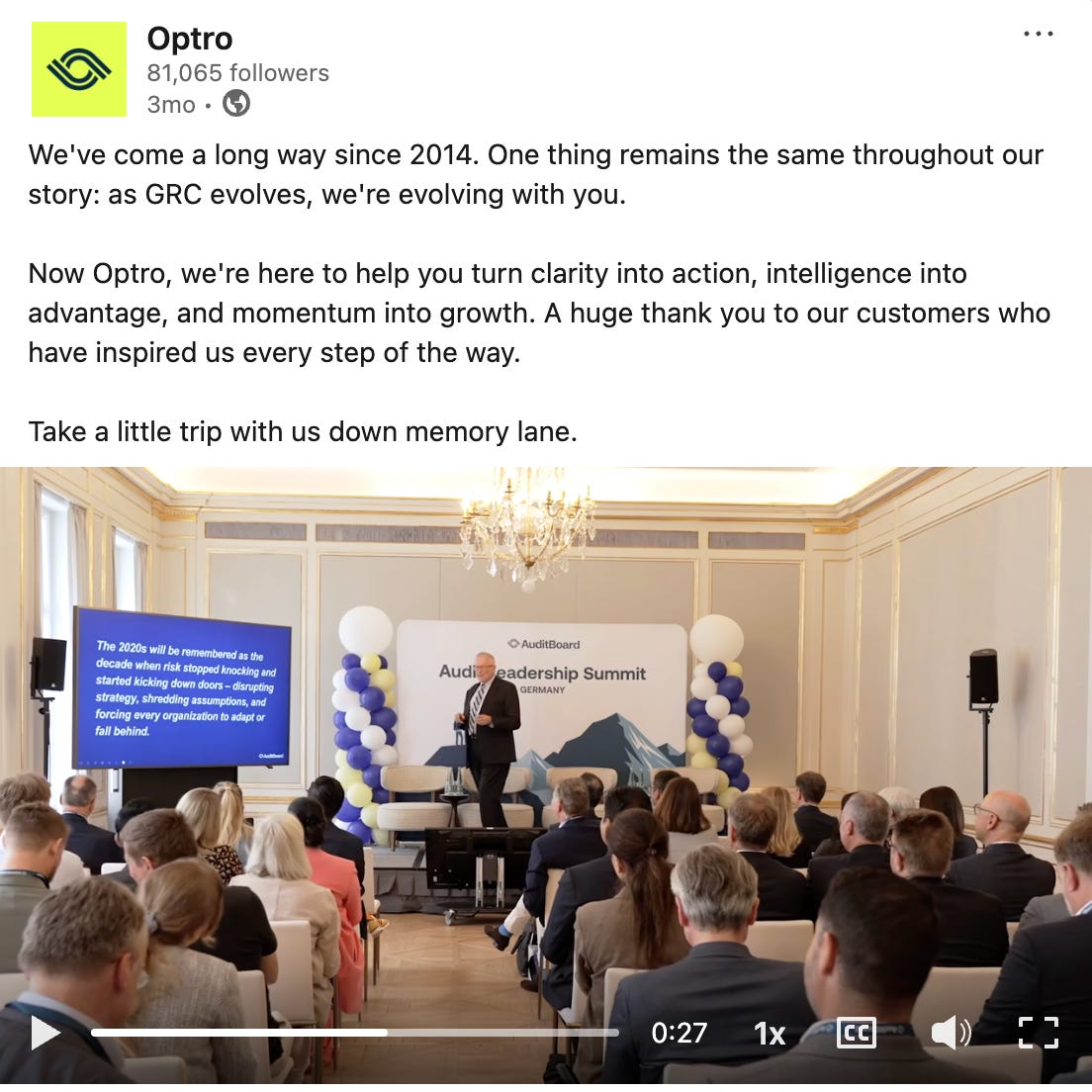
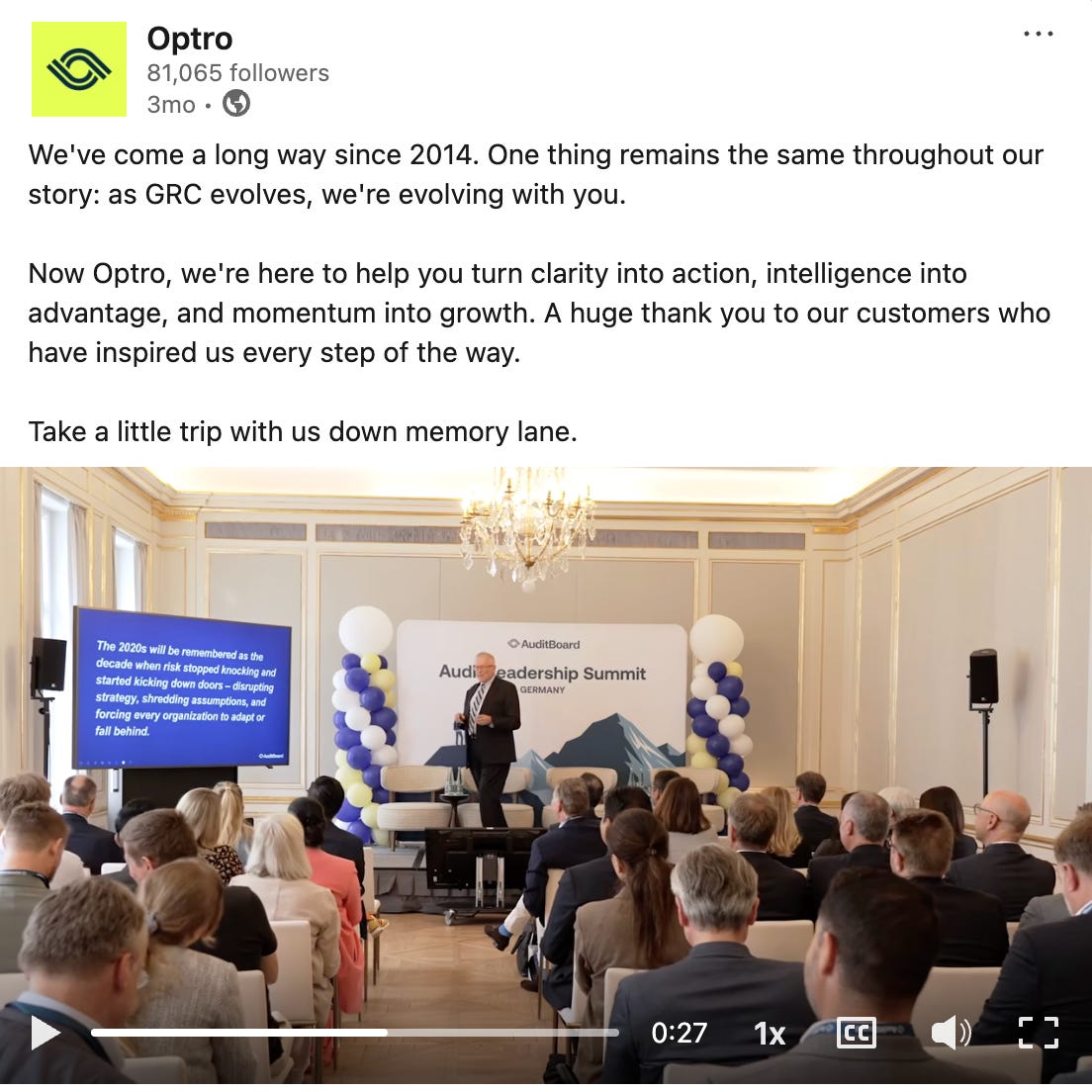
This video could’ve been 51 seconds about how the platform has evolved and where it is going. Instead it is a community story. It opens in 2014 with two friends and a simple idea, moves through “software built by auditors,” and lands on the line that gives the whole thing away: “customers became partners, a community formed.” The footage is shot-after-shot of Optro engaging with the GRC community. The close is “same people, same purpose, still listening, still building.” A company treating this as a marketing moment spends those seconds on capabilities. Optro spent them on the people who got them here.
Hold that in mind. It explains the rest.
The Rebrand
Cue The Anxiety: Walking Away From A Decade-Old Name
Can we first talk about how hard this must have been? Because it’s easy to underrate. AuditBoard had a decade of brand equity, a name people recognized, and a customer base most companies dream about. Making the decision to change is TOUGH. This isn’t swapping out a few colors and using new icons, a name is an identity. So let’s quickly hold a round-of-applause for the Optro crew!
The strategic logic is that the name had quietly become a ceiling.
“AuditBoard” anchored the company to a single discipline at the exact moment it was trying to claim the entire GRC surface and an agentic AI future. The name was telling a smaller story than the company had become. That is the cleanest justification a rebrand can have, and the launch materials make the case without a trace of defensiveness.
Renee Murphy, a former Forrester analyst, said it perfectly.
“Shedding a legacy name takes guts… When your product has grown this much, it’s not a rebrand, it’s just finally stepping into your true identity.”
That distinction holds weight. This was not a company running from its past. It was a company growing into a name that finally fit.
And notice how the community work doubles as risk management here. The “same people, same purpose” line in the history video is aimed directly at the customers most likely to feel unsettled about losing the name they signed up with. The community-first orientation is not separate from the risk. It is partly how they defused it.
Change You Can See, Continuity You Can Feel
The new identity is doing two jobs at once, and the way it balances them is beautiful.
The citron yellow is a Von Restorff move in a category that defaults to the “startup blue.” In a sea of sameness, the distinct thing is the thing you remember. You cannot mistake an Optro asset for anyone else’s now, and they applied that color with total consistency across the Nasdaq tower, the billboards, the booth, the merch, and every pixel of the digital footprint.
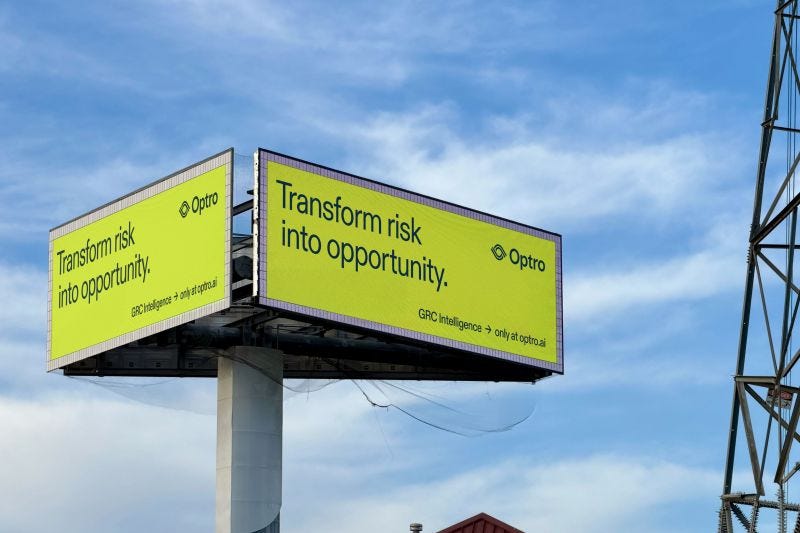
The logo mark does the quieter work. It is a clear evolution of the AuditBoard mark rather than a clean break, and the history video makes the lineage literal by dissolving the old navy mark into the new one. So the color screams change while the mark whispers continuity. For an audience that needed both novelty and reassurance, it’s a well-judged balance.
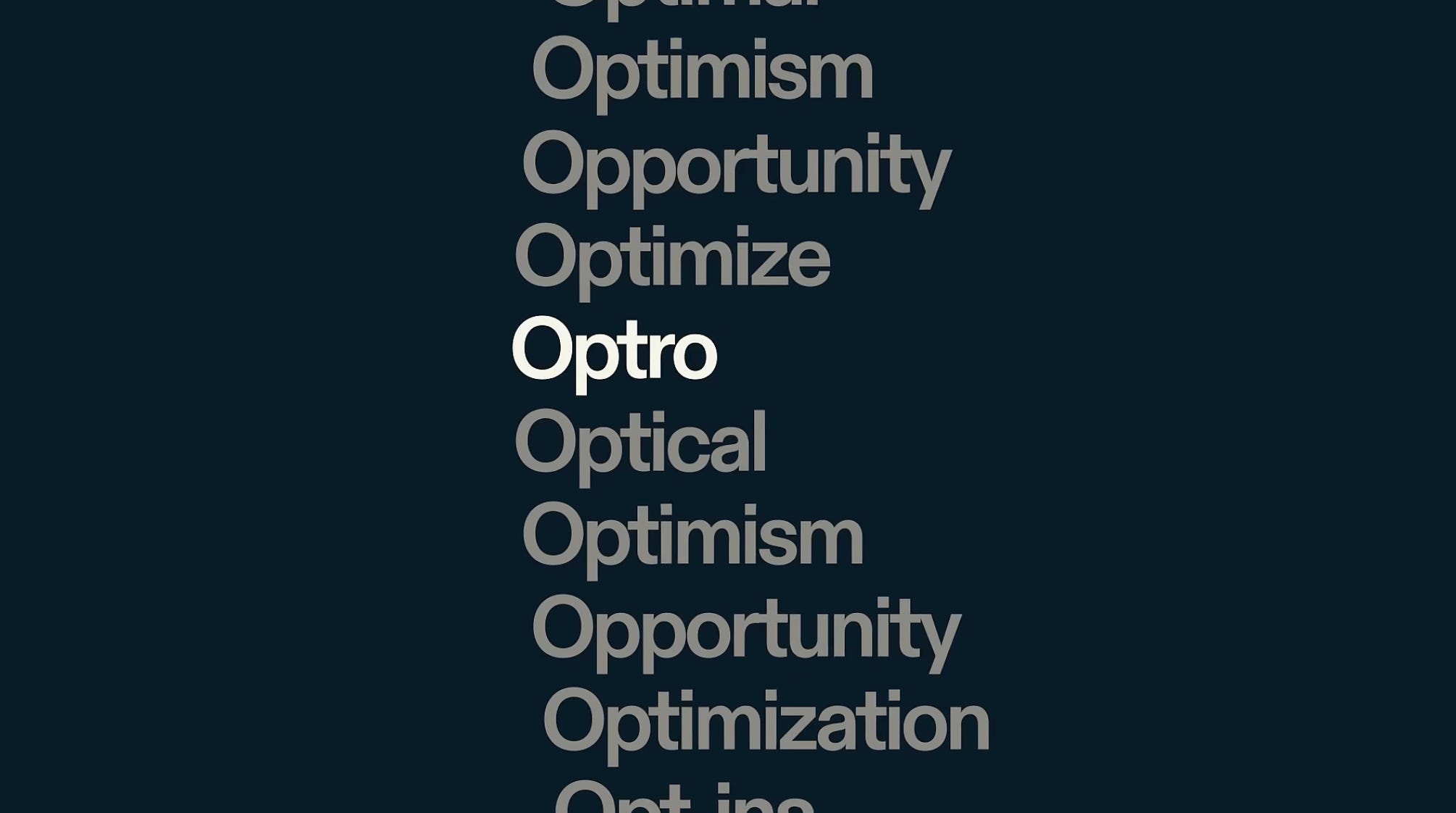
On the verbal side, the hardest problem with any coined name is that a new word means nothing on day one. Optro taught us about the new name rather than simply announcing it. “Transform risk into opportunity” gives the name a purpose, and the “Opt-” cascade in the launch film (opportunity, optimization, optimism, optical, optimal, etc.) walks the audience through the associations until the coined word starts to feel inevitable.
Richard Chambers reinforced it from the credibility side:
“Optro symbolizes the words that have always inspired GRC professionals: opportunity, optimizing, and optical.”
A Rollout With A Sequence, Not A Date
Most rebrands are a day. This one was an arc.
They launched at GAM, the Great Audit Minds conference, putting the new identity in front of the most concentrated gathering of the internal audit community first. These were the people who most needed to feel brought along rather than surprised, and they got the news in the room, under the Optro Space Station banner, before almost anyone else. Then the wave widened outward: the announcement and dual-account social handoff, earned media in Forbes, full page ad in the Wall Street Journal, the Nasdaq MarketSite tower, analyst and institutional validation, and finally RSAC, a second major event aimed at the information security net-new audience.
Read that sequence again. Community first, prospects second. The rollout is the community-first thesis made operational. It also behaves like a flywheel, each beat generating momentum for the next, so the rebrand kept compounding attention over months instead of spending it all in a single announcement.
Borrowing Trust From The Right People
For a rename, the central question is simple. Will people accept the new thing? Optro didn’t just assert the change, they surrounded it with proof from every direction.
A former Forrester analyst. The president and CEO of the IIA. Richard Chambers carrying the story in long form. The list goes on and on.
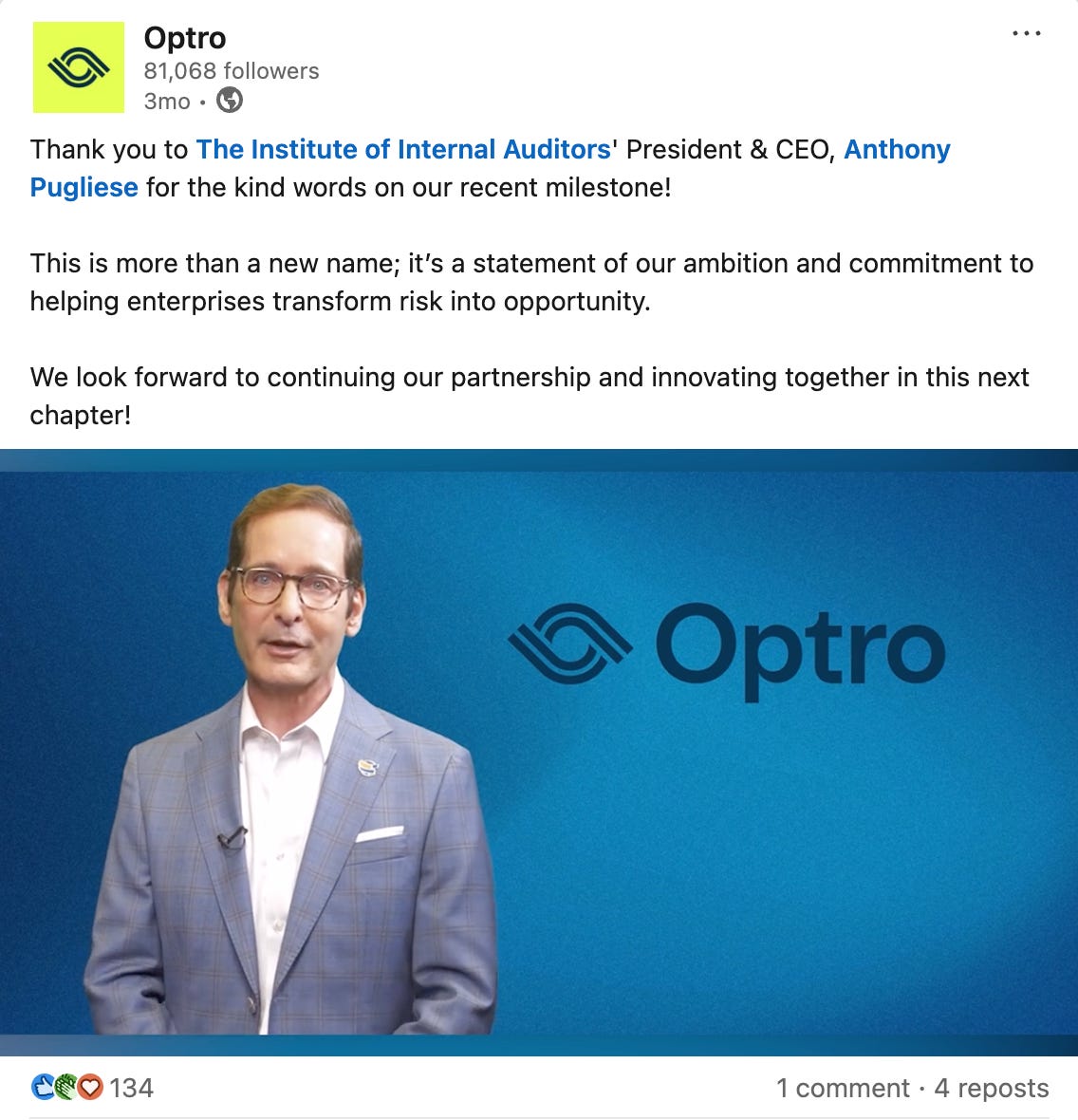
What makes this notable is not any single endorsement, it’s the range and coordination, arriving as one wave. And the validators are not random business authorities. They are figures the audit and GRC community already trusts, which works becuase this is an audience that weighs practitioner and peer credibility far above vendor assertion. No single proof point carries the rename. Stacked together, they make acceptance feel like a foregone conclusion.
A Note On What I’m Not Going To Do
This is the section where I normally tell you what I might have explored differently. I’m not going to here because I’ve personally never led a rebrand, especially one of this scale.
Critiquing The AI Anonymous campaign later in this post is fair game, because integrated campaigns are what I’ve been up to the last decade and have the standing to assess. But providing feedback on a full-company identity change is outside my lived experience, and I would rather withhold a critique than invent one to fill a section header.
But I will finish with this. There is one fact that blows my mind. From what Minou shared, the whole rebrand came together in under two quarters. The name, the identity, the website, the GAM activation, the analyst and institutional validation, everything.
In under two quarters… All I have to say is wow (and I hope the Optro marketing team is getting more sleep now).
The AI Anonymous Campaign
Let me start with my conviction first, because it shapes how I read this one. I believe the best marketing moves people. It reaches them emotionally, across whatever range of feeling fits the work, and it earns a place in their memory by doing so. Marketing that only informs gets filed and forgotten.
AI Anonymous moved me. The concept is a support group, “AI Anonymous, All Welcome, Free Donuts,” where people confess their AI disasters.
A chatbot trained on the company chat that started cussing at employees and sending inappropriate memes. An AI that summarized witness testimony in a big case and emailed the documents to opposing counsel. A performance-based termination handled by AI that went out as a birthday card reading “and by the way, you’re fired.”
The group recites its creed:
“I am smarter than my prompt history. I will verify before I amplify. When faced with a hard decision, I will not outsource my judgement.”
It’s not only the humor that makes it work. It’s the specificity.
The category default is to talk about “the risks of agentic AI” in the abstract, and abstractions are forgettable because nobody feels them. Optro dramatized concrete, recognizable failures instead, and that is the availability heuristic at work: a vivid, specific example makes a risk feel real and proximate in a way no statistic ever will. The comedy is the delivery vehicle. The specificity is the payload. Together they set up the “govern AI with confidence” positioning by contrast rather than by claim, which is the harder and more persuasive way to do it.
So that’s the praise. Now the part I do have the standing to push on.
What moved people was a video, not a campaign. This was a high-quality, high-investment film made deliberately for Connected TV, and it surfaced once on organic social with nothing built around it. No dedicated landing page. No campaign architecture. No cutdowns or content hub to extend its life. The energy a film like this generates needs somewhere to go, and here it had nowhere.
Regular readers know this is a drum I keep beating, because it keeps being the gap. Great creative deserves a destination that continues the story. NinjaOne’s Beat IT Misery campaign is a perfect example of what to do. An AI Anonymous landing page would have gone bonkers. The fact that the creative was good enough to deserve a full campaign is exactly why leaving it to stand alone stings.
The Ecosystem of Community-First Programs
Here is where the compounding really shows itself because the temptation is to read this as Optro doing the same community-first thing five times. It is not. It’s a coordinated portfolio that serves the community at five different layers, and the breadth is pure gold.
Educate them. Optro Academy, built in partnership with the IIA, offers a five-course series that helps auditors understand and apply emerging technologies, with CPE credit attached. This is outward generosity. CPE is a professional currency auditors earn to maintain certifications, so the program meets the community at a true need rather than manufacturing engagement. And co-creating curriculum with the IIA is halo by association of the deepest kind, a sustained working partnership embedded in a product. It educates practitioners about their profession in the AI era, with Optro as the implicit beneficiary rather than the subject.
Credential them. The Optro AI Professional certification is a different animal. Where the academy gives outward, the certification builds inward. It creates a credential practitioners wear publicly through a shareable badge, which is the Ikea effect at work, people value what they helped build and broadcast what they earned, and that broadcast is free advocacy. It feeds the Community Hub and deepens product fluency. This is the vendor-certification playbook run well, and it builds a base of credentialed experts who carry the brand into their own networks.
Recognize them. The Community Hub spotlights customers as the experts. The Lindsay Bingham feature, celebrating a lead internal auditor for leading a webinar that moves the profession forward, puts a member in the hero seat. Recognition is its own form of community investment, and it signals that the hub is infrastructure rather than a messaging line.
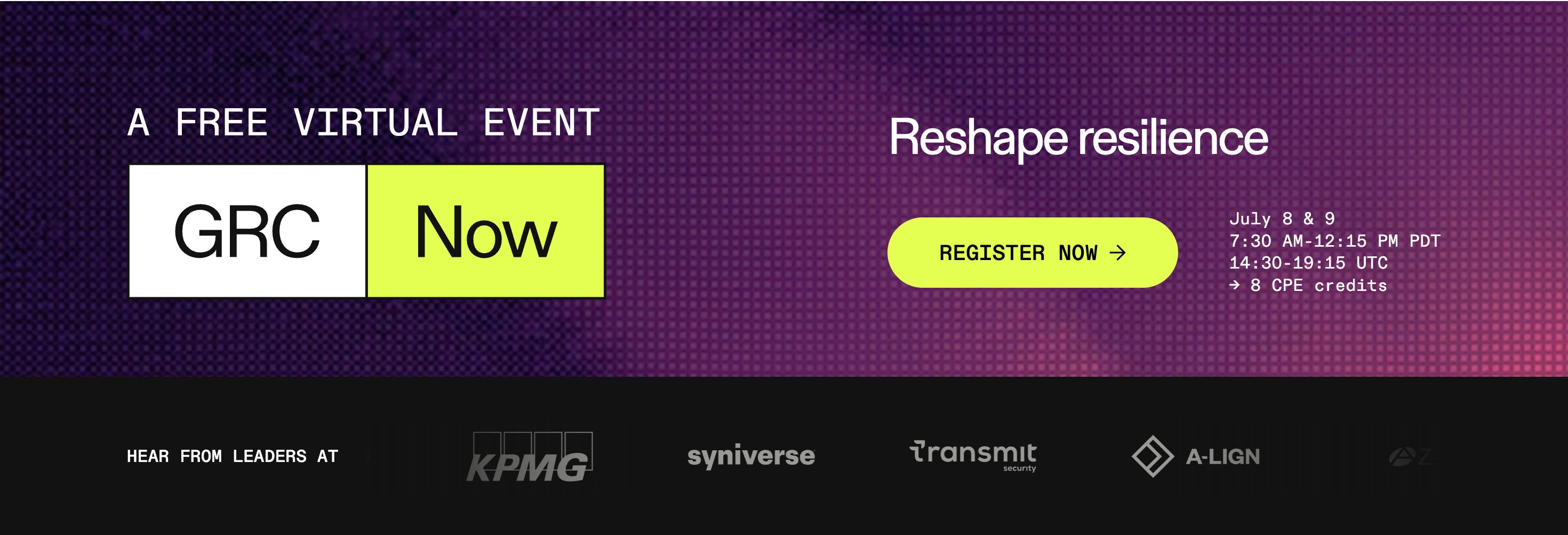
Convene them. GRC Now is a free, recurring, two-day virtual event carrying eight CPE credits and a draw of more than 15,000 peers. The session list is squarely the buyer’s world, from “compliance checkbox to strategic continuity” to “governing the autonomous enterprise” to “the identity paradox,” and the speaker lineup is predominantly external and high-caliber voices from Bank of America, Intel, KPMG, General Mills, and named security leaders, lightly hosted by Optro rather than stacked with it. The lineup drives attendance as much as the topics do, and a credible, cross-functional roster is the host-selection principle done right.
Inform them. The AI Governance Watch podcast, hosted by Optro’s GM of AI Governance, convenes policy, technology, and risk voices to unpack what responsible AI looks like in practice. A recurring host who shows up regularly builds the kind of parasocial familiarity that earns trust long before any sales conversation, and standing up a series on the “govern AI with confidence” positioning is a clear bid to own the conversation rather than rent attention in it.
Educate, credential, recognize, convene, inform. No single one of these would be remarkable on its own. Built together, deliberately, they form an ecosystem rather than a list. This is my compounding execution idea operating at the level of strategy, not just the level of an asset, and it is the clearest evidence that Optro is not running plays at random. They are building a system.
And system’s win championships. Go Knicks!
The Bottom Line
The easy version of this post is “Optro rebranded and it looked great.” That misses what is actually going on.
What Optro demonstrates is compounding execution across the entire marketing department. No single move here carries the company. The rebrand, the identity, the rollout, the validation, the campaign, the academy, the certification, the hub, the event, the podcast. Pull any one out and you still have a good program. Leave them together and you have something that’s great: a brand that feels complete, coordinated, and credible, executing in concert across every surface.
And underneath all of it is the thing Minou kept returning to. Every decision started with the community.
That is not a slogan you can reverse-engineer onto a campaign after the fact. It’s an orientation, and it is the reason these moves cohere instead of merely coexist. A company that starts from its audience builds a rollout that puts customers before prospects, a history film that thanks the people who got them there, and an ecosystem that gives more than it asks.
They did most of this in under two quarters. They did it while changing their name. And they did it without losing the thread that made the company worth following in the first place.
Optro, you officially have another raving fan!
Every week, I write about a marketing campaign in the cybersecurity software space that stands out strategically and/or has creative execution worth studying. And every quarter, I select three “Campaigns of the Quarter” where the marketers who led the campaigns receive a free, personalized Funko Pop. Yes, I’m serious. Here’s mine as proof:

If you’ve led a campaign you’re proud of or know someone who has, message me on Substack or LinkedIn to submit it. I want to see what you’re building.
Originally published on Campaign Telemetry.
Read on Substack