Vanta Customer Week
A quick note: Everything I’m sharing here is my subjective take on the Vanta Customer Week campaign as I’m not privy to their performance metrics or strategy. The recommendations at the end are offered with deep respect for the Vanta marketing team and is purely a thought exercise in how I might have approached certain elements differently.
Over the past few days, I've been doing a deep dive into Vanta Customer Week, now in its third year, and this is one of the more thoughtful customer marketing campaigns I've seen in the security space. Buckle up because there is so much goodness.
What is Vanta Customer Week?
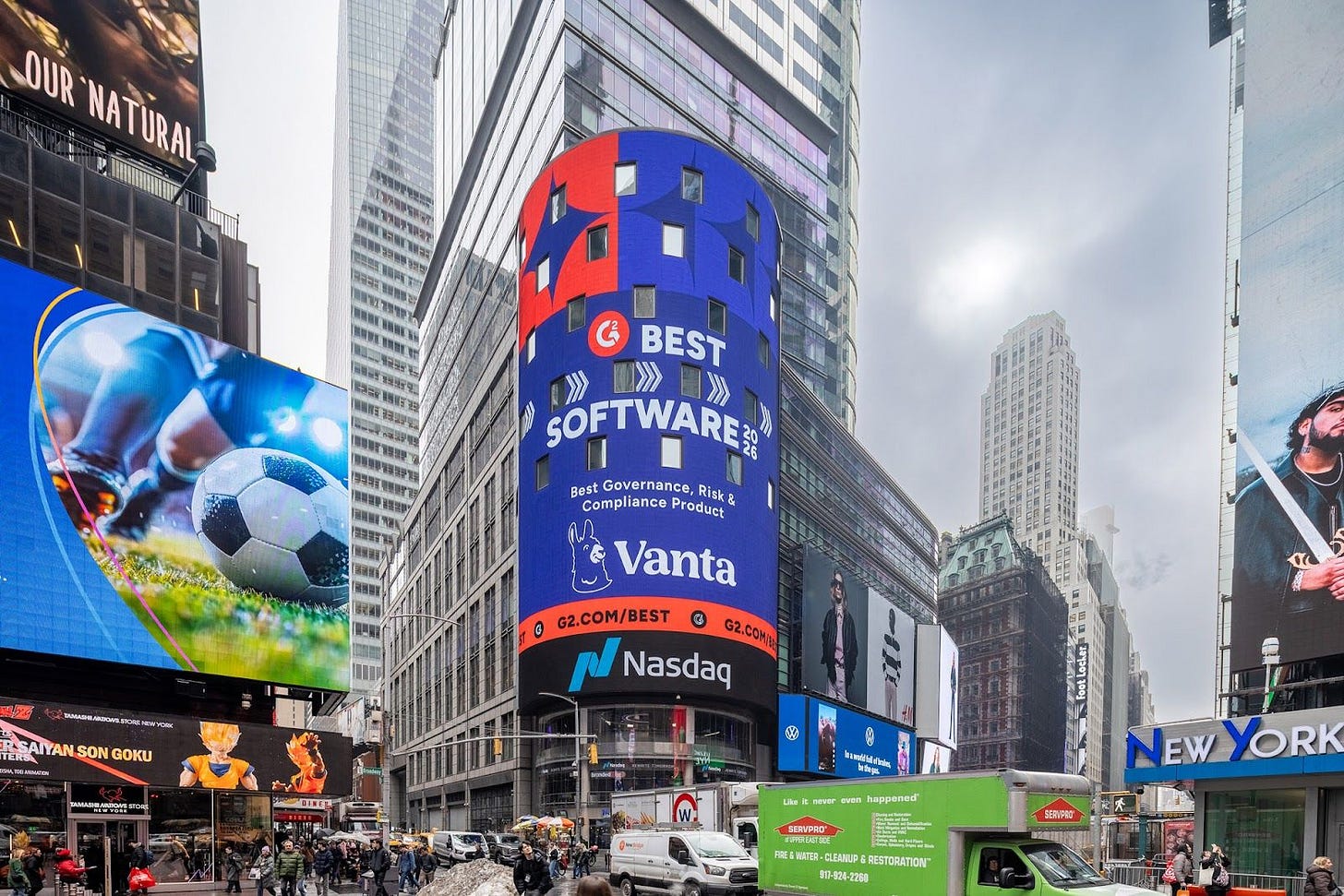
Vanta Customer Week is an annual, week-long campaign celebrating the security & GRC leaders who are doing the hard, often thankless work of building trust. This year, the campaign included four new customer stories featuring GitHub, Perforce, DocGo, and Accumulus Technologies, a webinar with leaders from GitHub and Modern Treasury, the launch of a new product feature (Customer Commitments, now in public preview), the announcement of a Slack-native customer community, and the opening of nominations for the Vanta 25 to Trust Awards. Oh, and Vanta hit 15,000 customers and was ranked #1 in G2’s Best GRC Software. Again.
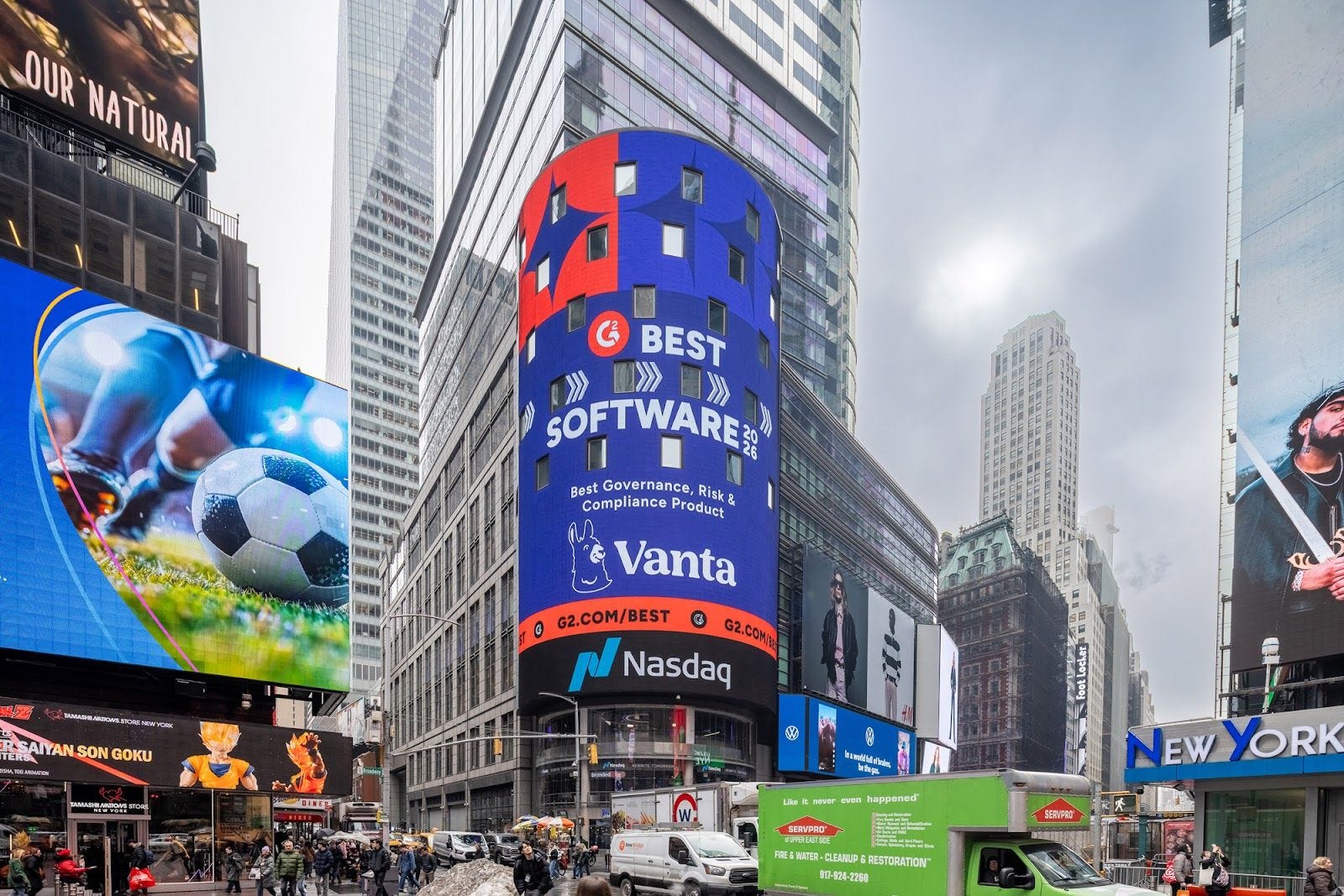
That is a lot to pack into five business days. I get nervous when a campaign with this short of a timeline has this many announcements… but Vanta pulled it off.
What Vanta Got Right
Exceptionally Produced Customer Stories
"Marketing is no longer about the stuff that you make, but about the stories you tell." - Seth Godin
Vanta took this to heart.
Each of the four customer stories came with a 90-second video that followed a clean, tight narrative arc: introduce the company, define the pain points, explain how Vanta solved them, show the business impact, and point to what’s next. This is harder to execute than it sounds. Most customer videos run too long, meander through vague ROI claims, and leave you with a sense of “that sounds nice” without any real conviction. These didn’t do that.
The written customer story pages matched the quality of the videos (see Accumulus Technologies story). Each one was structured around:
A TL;DR section
The Company section
The Challenge section
And The Vanta Impact section
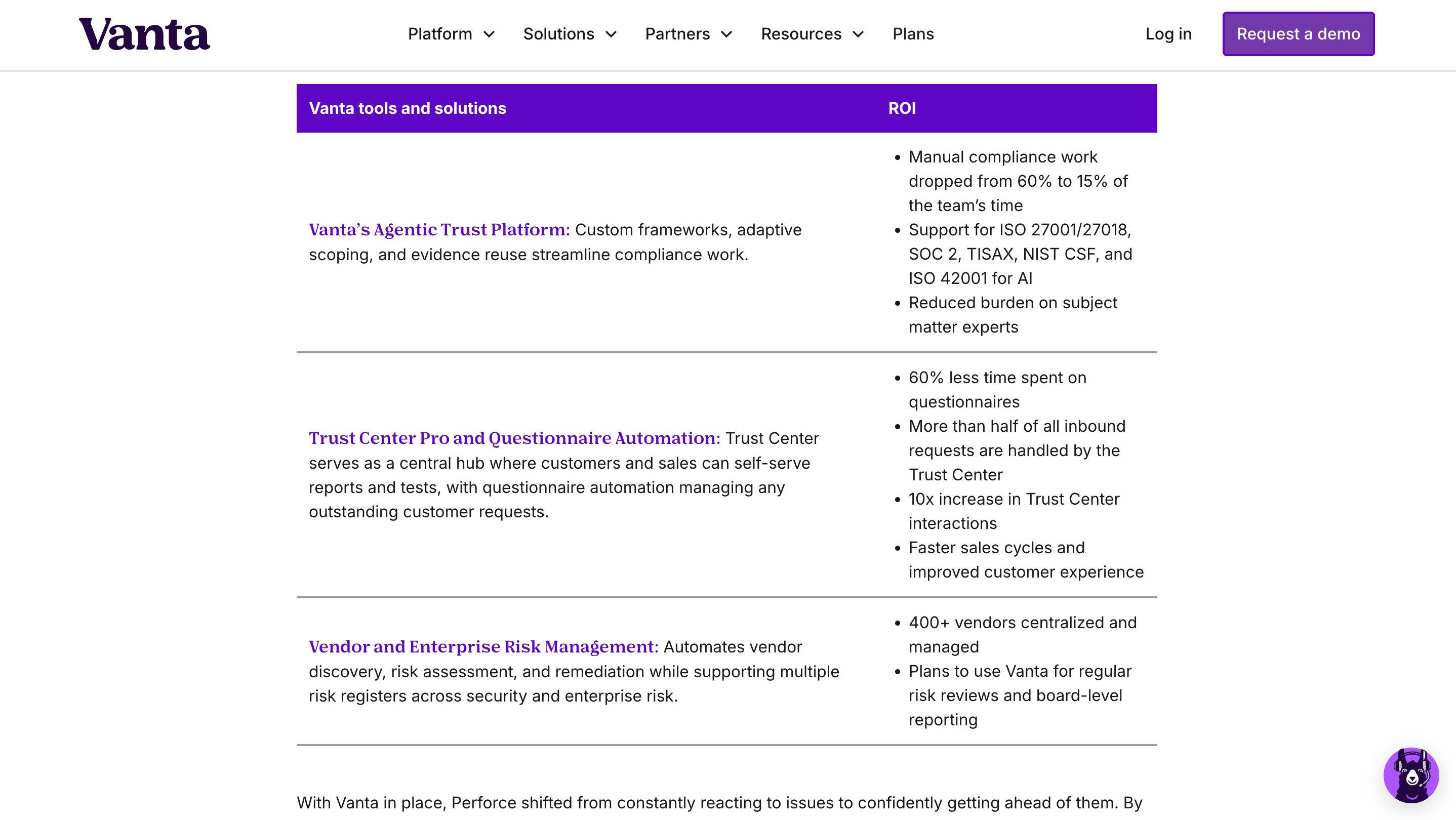
This gives you everything you need without burying you in detail. But the element I want to specifically call out is the Product x ROI table embedded in each story. This format does something most customer content fails to do: it connects specific Vanta products to specific, measurable business outcomes in a way that a practitioner can actually internalize. Thirty to forty hours saved per questionnaire. Three to four weeks saved per deal cycle. ISO 27001 compliance fast-tracked. These aren’t vague claims. They’re proof points a GRC leader can use to justify a budget conversation.
Similar to the Axonius CTRL/ACT virtual event, the attention to detail here was extraordinary. Nothing felt like an afterthought. From the hero section of each customer story page surfacing important characteristics of the customer (location, industry, company size, and products used) to the thematic consistency across every asset in the campaign, you could feel the intentionality behind every decision.
There's also a psychology principle at work here worth naming: social proof. The security and IT audience is one of the most skeptical buyer audiences in B2B. They trust their peers far more than they trust vendors. They have private groups and community forums where they share vendor recommendations candidly. They know that a CISO or Director won't put their name on a customer story unless the product genuinely moved the needle for them. When Vanta gets four of them on record across different company sizes and use cases, that's not just content. That's peer validation at scale.
Range of Customers Artfully Done
Accumulus Technologies at approximately 70 employees. DocGo and Modern Treasury in the mid-market. Perforce at approximately 2,000 employees. GitHub at over 5,000. Whether this was deliberate or instinctive, it was brilliant. Vanta has long carried the perception of being a compliance tool for startups. By featuring customers across this full spectrum of company sizes, without ever saying “we’re not just for startups,” Vanta quietly dismantles that perception.
The same logic applies to the mix of Vanta products featured across the stories. Each customer used a different combination of solutions, which showed the depth and breadth of what Vanta can do and the many different problems they can solve.
Executive Titles Were Deliberate & Smart
Two CISOs and two Directors. This isn't a small detail. It reflects a genuine understanding of the B2B buying committee in the security space. The CISO provides executive credibility that Vanta is a core tool in the security stack. The Director, who is typically one of the closest people to the actual pain, gives practitioners someone who can speak to the day-to-day reality of the problem. Smart customer marketing teams know you need both. Vanta did. Should we be surprised?
Vanta 25 to Trust Awards: A Genuinely Differentiated Program
I’ve seen a lot of “Top CISOs of the Year” lists from security vendors. Most of them are thinly veiled celebrations of their top target accounts, selected internally, and the security community knows it. CISOs have spoken openly about this. It doesn’t feel earned, which continues to feed the CISO <> vendor trust fracture.

The Vanta 25 to Trust is different in two important ways. First, nominations are open to the broader security and compliance community, not just Vanta’s internal teams. That distinction matters enormously to a highly skeptical audience that can smell vendor self-interest from a mile away. Second, there is something tangible in it for the winners beyond a badge on LinkedIn. The five category winners are invited to VantaCon to receive their award in person. That’s real recognition, not performative recognition.
Here's the psychology principle I want to highlight: the Ikea Effect. The Ikea Effect is the well-documented phenomenon where people place significantly higher value on things they helped create. By opening nominations to the broader community, Vanta is giving the security world a hand in building this award. The community doesn't just receive the recognition, they shape it. That sense of ownership and co-creation makes the program feel genuinely theirs, which is exactly why it lands differently than a vendor-curated list ever could.
This also brings me to a principle I talk about constantly: campaigns and events should drive momentum for each other, not compete with each other or exist as isolated starts and stops. Vanta Customer Week celebrates the community. The Vanta 25 to Trust honors the best of that community. VantaCon is where it all culminates. Each moment creates anticipation for the next. That flywheel is something Vanta should be deliberate about protecting and continue to expand.
Customer Story + Webinar One-Two Punch
The "Committed to Trust: How Our Customers Turn Promises into Proof" webinar featuring leaders from GitHub and Modern Treasury was an important complement to the customer story content. The stories give you the what. The webinar starts to give you the how. Daily workflows, what worked, what didn't, how trust becomes a growth driver. This is the kind of content that moves a prospect from "interesting" to "I need to talk to someone at Vanta." It exists for GitHub. The next step is to extend it to DocGo, Perforce, and Accumulus Technologies. If Vanta does that next year, then they can expect dollars to rain down on that purple llama.
Integrated Feature Launch vs Isolating It
Customer Commitments, Vanta's new feature that lets you centralize, track, and act on every promise you've made to customers, launched inside Vanta Customer Week as a sneak peek during the webinar. This feature could have been announced on its own, on any random Tuesday. Instead, Vanta embedded it inside a week already dedicated to the theme of trust and customer relationships. The thematic alignment is almost too perfect.
And this is a discipline that larger marketing teams genuinely struggle with. As orgs scale, teams silo, and launches become disconnected events rather than chapters in a coherent story. Vanta chose integration over isolation; choosing to tease this feature in the Vanta Customer Week campaign then hard launching it within the Security Theater campaign which is an exceptional campaign in it’s own right. I’m jumping out of my seat here. I’m a hard critic, but Vanta did this PERFECT.
Vanta Didn’t Forget to Unlock the Business
Kaitlin Pettersen, Head of Customer Engagement at Vanta, mentioned in her LinkedIn post that Nick Hardy, Sr. Director of Security GRC & Program Management at Samsara, presented an internal customer interview to the Vanta team during Vanta Customer Week. This is a big one. Many marketing teams are so consumed with their external distribution plans that they forget one of their highest-performing channels: the business. The volume of Vanta employee reposts on Vanta Customer Week LinkedIn posts is a signal that this internal activation worked. That reach doesn't happen by accident. It happens because someone made sure the team felt connected to the campaign and motivated to share it.
What I Might Have Explored Differently
Give Us a Vanta Customer Week Hub!
This is the observation I keep coming back to. Vanta Customer Week doesn’t have a dedicated landing page that serves as the home base for the campaign. There was a nominations page for the Vanta 25 to Trust that quietly housed the customer stories, the webinar, and the community announcement further down the page. But you would have no idea that page was acting as a hub because its title and primary purpose was announcing award nominations. It was an accidental hub. The instinct to bring things together was clearly there. The execution just needs to be a tad bit more deliberate.
A purpose-built hub changes everything. It becomes the campaign’s hero asset, the single destination that banners, modals, social posts, emails, and paid ads can point to for the story and full collection of resources. It makes cross-promotion effortless. It keeps the campaign discoverable long after the five days are over. And it unlocks a full website takeover strategy that currently has nowhere to land.
Website Didn’t Seem to Be Activated
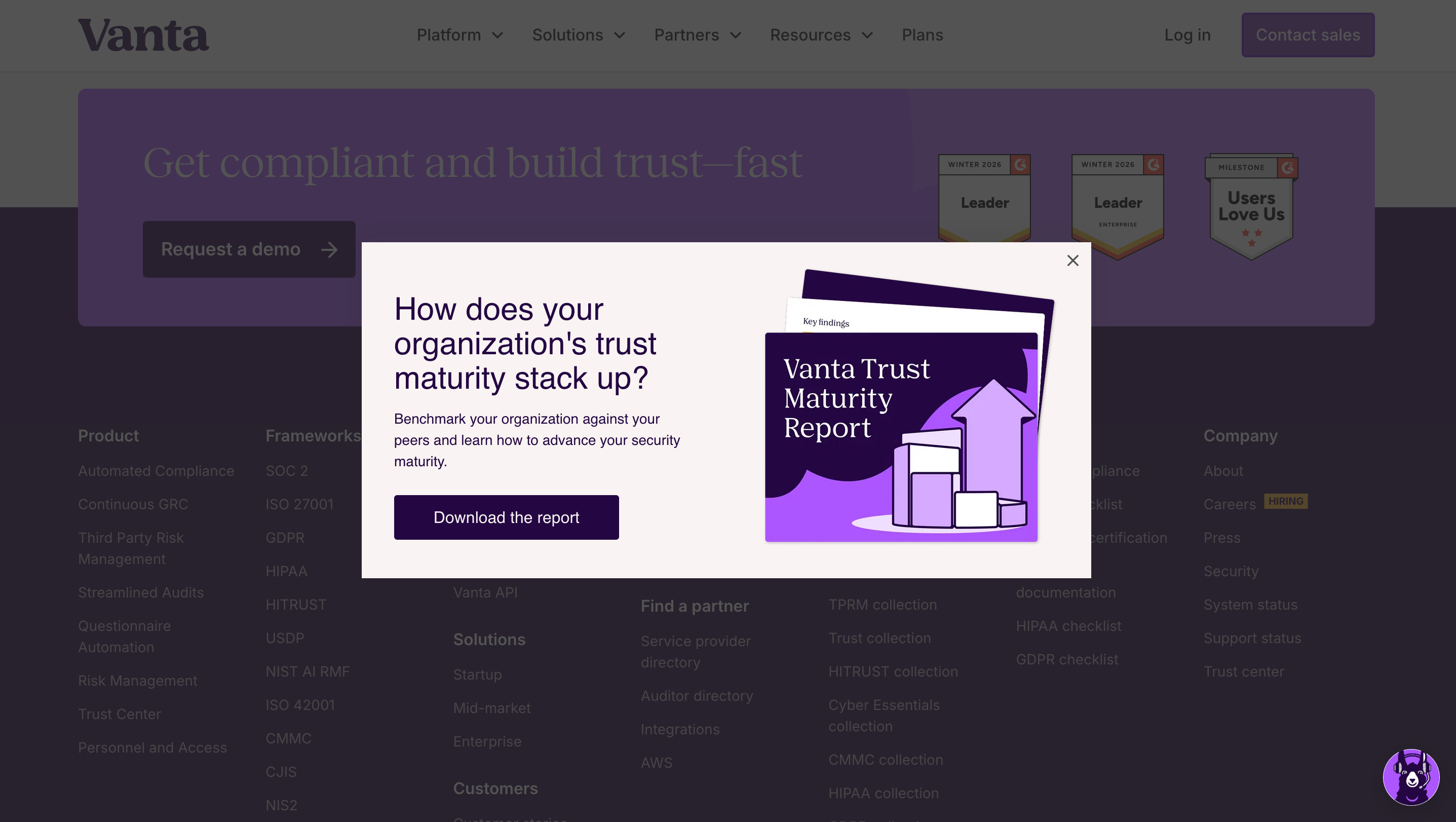
Vanta clearly has the modal infrastructure in place. There’s a well-designed pop up modal running for the Vanta Trust Maturity Report. That same capability could have been pointed at Vanta Customer Week. A global sticky banner across every page of the site. A secondary CTA in the hero section of the homepage. An exit intent modal. Inline blog banners across the top 10 to 20 most visited posts. These are fast to implement, fast to remove, and powerful for a five-day campaign window with no competing announcements to crowd out the message.
For a campaign built on customer stories, the highest-trust content Vanta produces, driving more of the site’s existing traffic into that content is a no-brainer. Especially for the security and IT audience, who are notoriously skeptical of vendor claims and deeply influenced by the words of their peers. A full website takeover anchored in customer stories isn’t Vanta saying “look how great we are.” It’s Vanta’s customers saying it on their behalf. That’s a fundamentally different message, and the security community knows the difference.
Absence of Paid Media Distribution
After checking the Google Ads Transparency Center, LinkedIn Ads Library, and Meta Ads Library, I can confirm that none of the assets, not the customer story videos, not the G2 recognition, not the Vanta 25 to Trust nominations, were supported by paid media on any channel. There was also no press coverage and no distribution through major cybersecurity publications like SC Media or Security Week.
To be completely fair, the organic performance was genuinely impressive. 887 engagements and 183 reposts across six LinkedIn company page posts, with all four customer champions actively engaging with their own stories. I’d estimate the total organic impression count cleared a six-digit number which for zero paid spend is a win. All four customer champions, Stepheni Norton at Accumulus Technologies, Eiwe Lingefors at DocGo, Aaron Kiemele at Perforce, and Megan Snyder at GitHub were active in the comments and shares. When their networks see a security leader they respect vouching for Vanta in their own feed, that’s peer credibility you simply cannot buy.
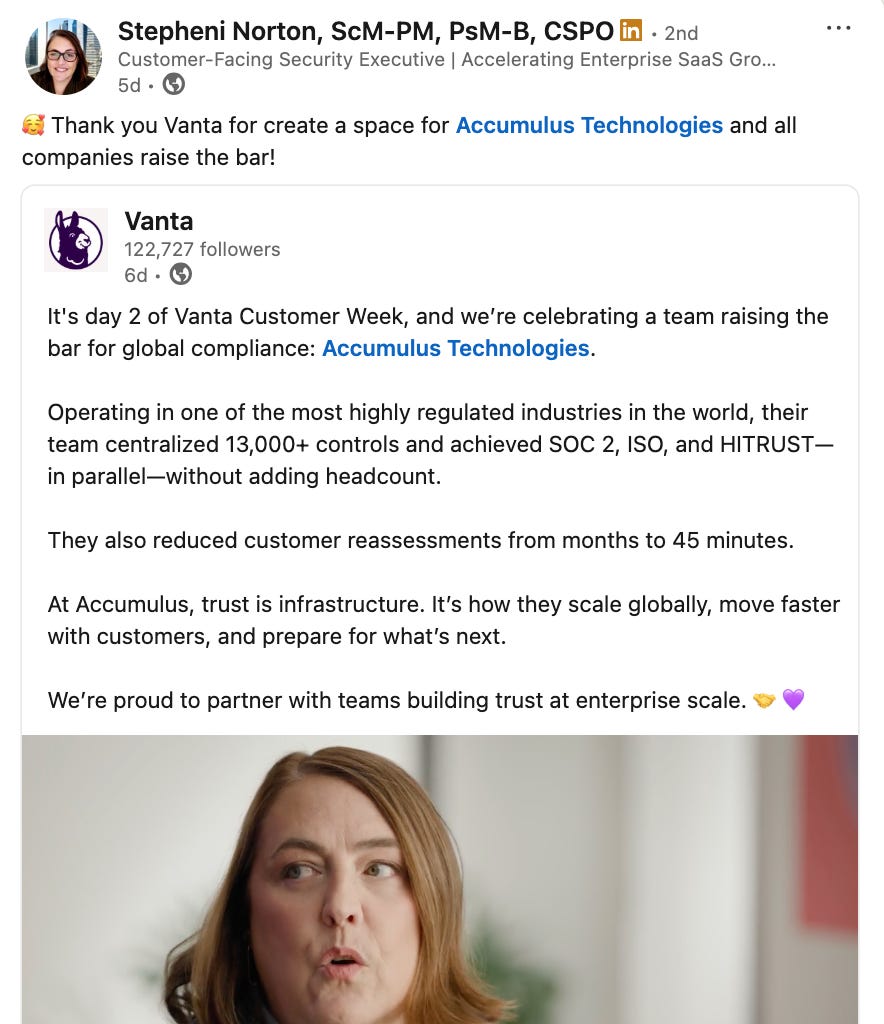
But here’s what it comes down to: when your organic foundation is already performing at that level, paid amplification doesn’t replace it. It multiplies it. Ninety-second customer story videos from GitHub and DocGo would have performed exceptionally well as YouTube pre-roll or LinkedIn sponsored content targeted at the security and GRC audience. The G2 #1 ranking warranted a press release and outreach to SC Media and Security Week, where earned coverage would have reached exactly the practitioners Vanta is trying to influence. Retargeting anyone who visited the customer story pages or the nominations page during the week could have extended the campaign’s momentum well beyond five days.
The creative was prospect-ready. The distribution wasn’t prospect-focused.
Test a “Speak to a Vanta Customer” CTA
Here’s an idea I would have loved to see tested during the week. Vanta has a chatbot running across their customer story pages. What if, for five days only, that chatbot surfaced a “Speak to a Vanta Customer” CTA?
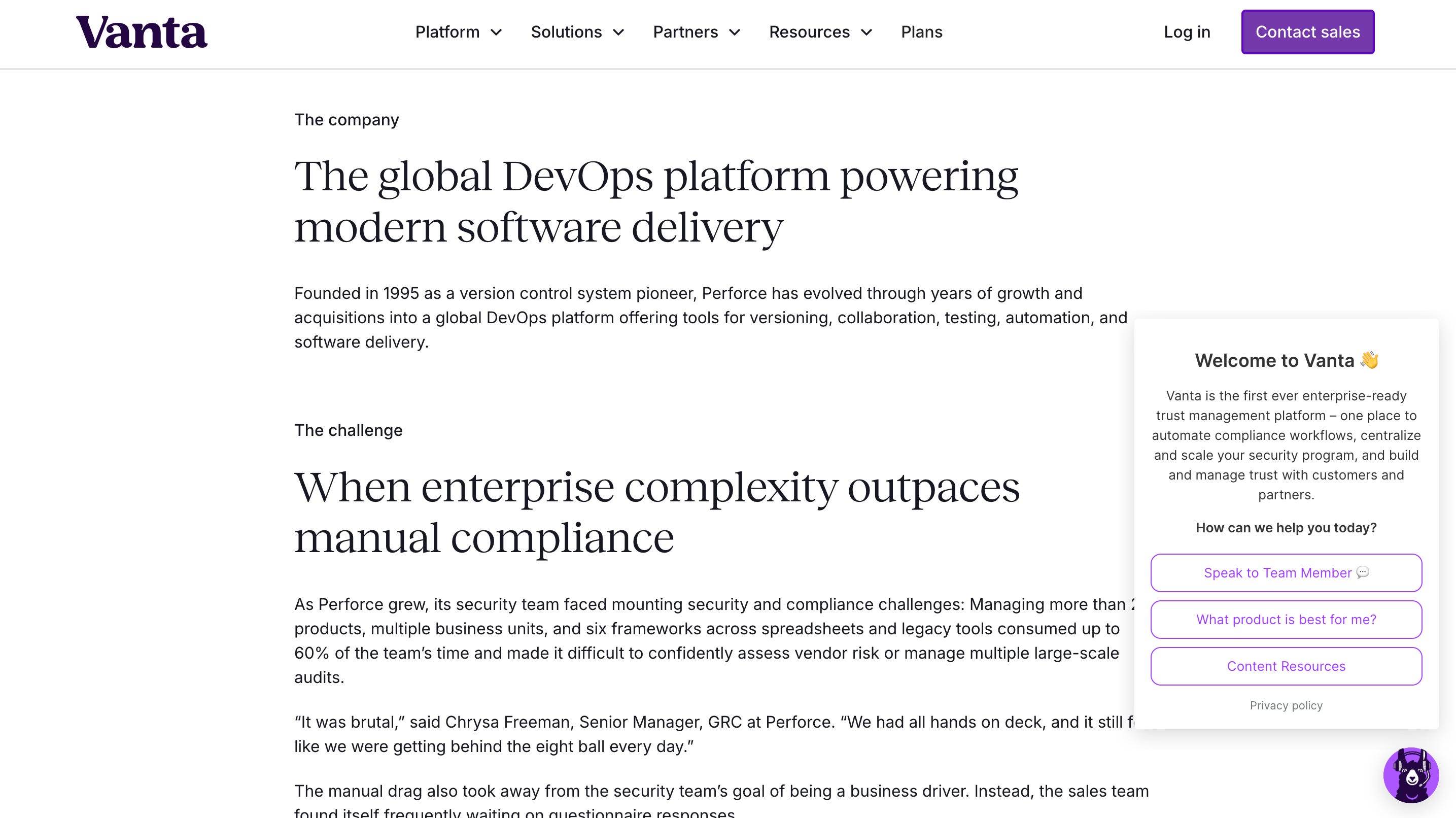
The flow would work like this: a website visitor expresses interest, fills out a short form, a BDR and Customer Marketing Manager pairing work together to qualify the lead and connect them with a referenceable Vanta customer matched by company size, industry, and region. Not a sales rep. Not a demo. A peer conversation with someone who has already been through the evaluation, made the decision, and lived with it.
I’d be willing to bet the conversion rate to closed won for these leads would be among the highest Vanta generates all year. The security audience doesn’t want to be sold to. They want to talk to someone who looks like them and made the same decision. This CTA creates exactly that moment. It’s not something you could run year-round without straining the referenceable customer program, but as a Vanta Customer Week exclusive it would feel special and extraordinarily high-value for the right prospect.
Customer Stories Could Go Deeper
The short-form format of the stories is the right call for awareness and initial credibility. But I found myself wanting to understand more granularly how Vanta solved the problem, not just that it did. The workflow webinar format that exists for GitHub is the answer to this, and extending it to the other three customers would close that gap significantly. These don’t need to be long. Fifteen to thirty minutes, on-demand, with the customer walking through the actual workflows inside the platform (using dummy data of course). Done right, they build significantly smarter and more eager buyers, and those are the quickest and easiest to become customers.
There’s also an opportunity in how customer stories surface on the site. A backend architecture that recommends stories based on company size and industry would make the content work harder long after this campaign ends. Prospects don’t just want social proof. They want social proof from people who look like them.
And lastly, all four customer stories featured US-based companies. For a company with clear global expansion ambitions, the absence of international representation feels like a miss worth correcting next year.
The Bottom Line
Vanta Customer Week is one of the best-executed customer marketing campaigns in the B2B security space. The production quality is high, the strategic intent is clear, the content is genuinely useful to the audience it’s meant to serve, and the internal activation was done right. What holds it back from being a truly complete campaign is the distribution gap. A dedicated hub, a website takeover, paid amplification, and press coverage would have taken a campaign that performed well organically and turned it into something that reached well beyond Vanta’s existing audience.
The foundation is strong. The blueprint is there. Year 4 has everything it needs to be exceptional.
I continue to be incredibly optimistic about what Vanta is building, not just the product, but the marketing around it. That is where I stand and that is what I continue to both see and believe.
Every week, I write about marketing campaigns in the cybersecurity software space that stand out strategically and/or have creative execution worth studying. And every quarter, I select three “Campaigns of the Quarter” where the marketers who led the campaigns receive a free, personalized Funko Pop. Yes, I’m serious. Here’s mine as proof:

If you’ve led a campaign you’re proud of or know someone who has, message me on Substack or LinkedIn to submit it. I want to see what you’re building.
Originally published on Campaign Telemetry.
Read on Substack